
Zoom F3 Professional Field Recorder
4.6Editor score
32-bit float recording
Dual XLR inputs
Ultra-low-noise preamps
Discover the top audio field recorders for film in this expert guide comparing features, inputs, timecode, and sound quality for filmmakers.
Capturing high-quality audio is essential for any film project, and choosing the right field recorder can make a significant difference in your final production. With so many options available, understanding the key features that matter most for filmmaking is crucial to selecting the right tool for your needs.
This guide compares ten top-rated audio field recorders designed specifically for filmmakers, musicians, and content creators. We evaluate each device based on input options, recording quality, timecode capabilities, portability, and overall value to help you find the perfect match for your workflow.
Each pick in this list highlights specific strengths and ideal use cases, from budget-friendly handhelds to professional multi-track recorders. Keep in mind that product availability and pricing may change over time, so verify the latest details before making your final purchase decision.
4.6Editor score

4.7Editor score
4.6Editor score
The following table provides a side-by-side comparison of all ten featured audio field recorders, highlighting their core specifications and primary strengths for film production workflows.



The Zoom F6 Professional Field Recorder stands out as a top choice for filmmakers seeking professional audio quality without excessive bulk. With a rating of 4.7, it offers 32-bit float recording that captures everything from whispers to explosions without clipping.
We may earn a commission when you buy through this link, at no additional cost to you.
Its six XLR inputs allow simultaneous recording of multiple microphones, making it ideal for complex sets. The timecode I/O ensures frame-accurate sync with video, while its rugged design withstands challenging conditions on location.
While the price is higher than handheld models, the versatility and reliability justify the investment for serious productions. Some users may find the menu system requires time to master, but the benefits outweigh this initial learning curve.
Film professionals who need reliable multi-track recording and precise synchronization should prioritize the F6. Its balance of portability and advanced features makes it a powerful tool for demanding audio workflows.
This technology captures massive dynamic range, ensuring no audio peaks are lost even if levels spike unexpectedly.
Built-in timecode I/O keeps audio tracks perfectly aligned with video frames for efficient post-production editing.
We may earn a commission when you buy through this link, at no additional cost to you.
The Zoom F3 is an excellent entry-level option for filmmakers on a budget who still require professional audio capabilities. Its 4.6 rating reflects strong performance in capturing clear sound without distortion thanks to 32-bit float technology.
We may earn a commission when you buy through this link, at no additional cost to you.
Designed for run-and-gun filmmaking, it handles quiet dialogue and sudden peaks without needing constant adjustments. The dual locking XLR inputs ensure secure connections even when the recorder is mounted out of reach during shoots.
The main trade-offs are the limited two inputs and lack of native timecode, which may restrict complex setups. However, for solo operators or small crews, these limitations are often acceptable given the affordable price point.
Creators looking for reliable audio quality without breaking the bank will find the F3 a smart investment. It delivers professional features in a compact package ideal for independent productions.
The F3 captures dynamic audio without needing manual level adjustments, perfect for fast-paced filming environments.
Dual locking XLR inputs prevent accidental disconnections when the recorder is mounted or part of a larger rig.
We may earn a commission when you buy through this link, at no additional cost to you.
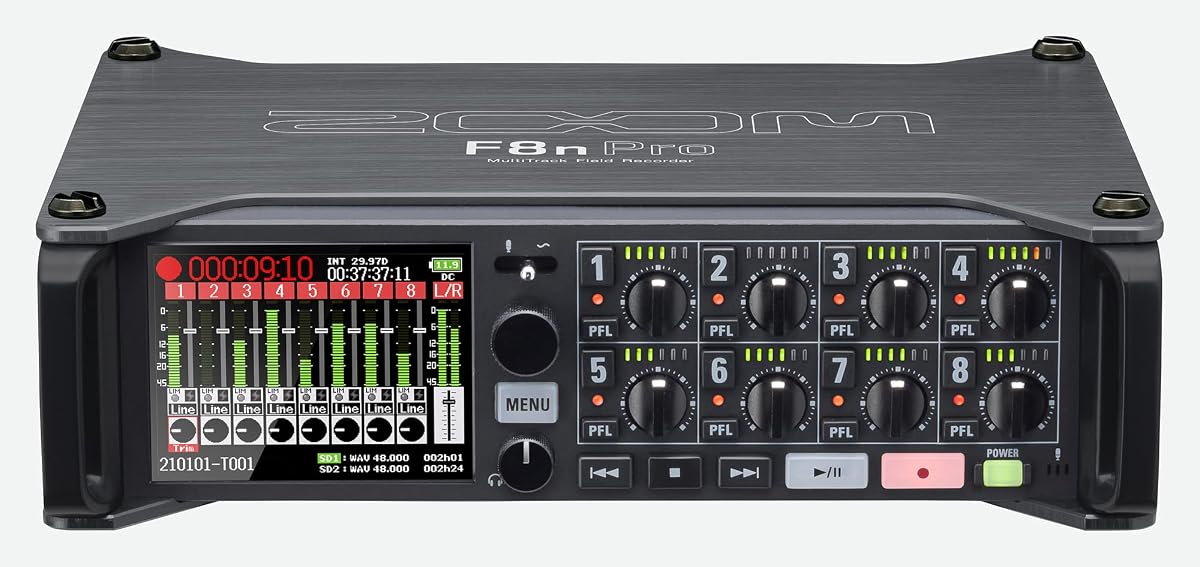
The Zoom F8n Pro represents the pinnacle of portable field recorders with its 8-channel capacity and advanced features. Rated 4.6, it is built for professional film and field audio where every detail matters for final sound design.
We may earn a commission when you buy through this link, at no additional cost to you.
Its 32-bit float recording and dual AD converters ensure clip-free audio across the full dynamic range. Timecode accuracy down to 0.2PPM guarantees perfect synchronization with video, while dual SD slots provide redundant recording safety.
The main drawbacks are the higher price and weight compared to more compact recorders. For productions requiring maximum input flexibility and backup security, these compromises are minor compared to the robust capabilities it offers.
Professional crews and high-budget productions should choose the F8n Pro for its unmatched reliability and feature set. It delivers comprehensive control for complex audio scenarios on set or location.
Dual SD card slots allow simultaneous recording for backup, ensuring no critical takes are lost due to card failure.
Industry-leading accuracy keeps audio tracks aligned with picture for seamless editing in post-production workflows.
We may earn a commission when you buy through this link, at no additional cost to you.
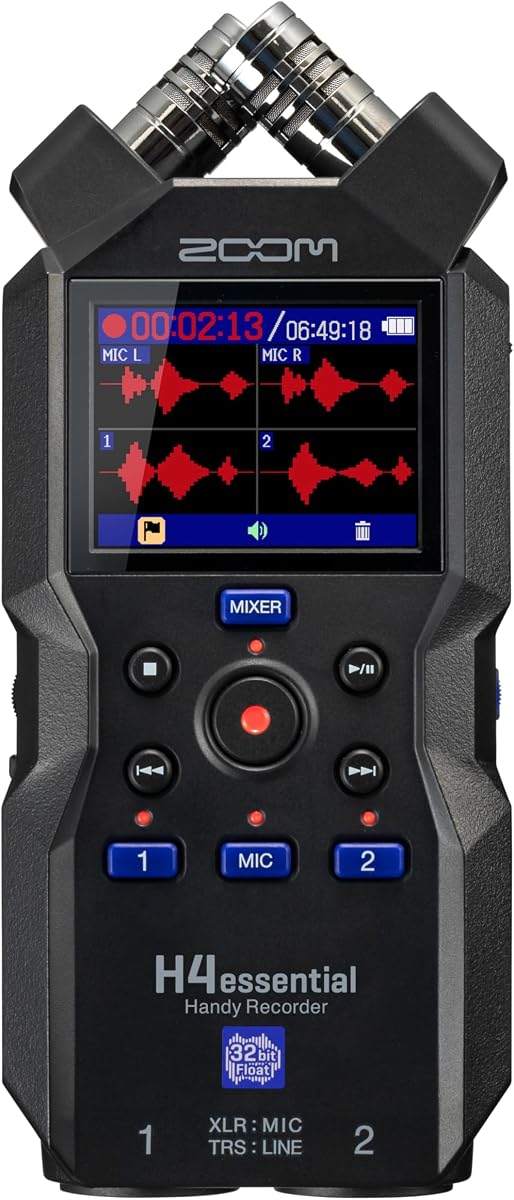
The Zoom H4 Essential is a versatile handheld recorder suitable for musicians, podcasters, and filmmakers needing reliable audio capture. With a 4.4 rating, it offers a balanced mix of features that suit various creative workflows effectively.
We may earn a commission when you buy through this link, at no additional cost to you.
Its built-in stereo microphones allow quick recordings without external gear, while two XLR/TRS inputs accommodate external mics. The USB-C connection enables direct recording or streaming to devices, adding flexibility for modern setups.
The lack of timecode and limited inputs make it less ideal for complex film production, but it works well for interviews or simple scenes. Spoken menu guidance enhances accessibility for users needing easier navigation.
Creators who need an all-in-one solution for diverse audio tasks will appreciate the H4 Essential. It combines simplicity with enough power for many everyday recording needs.
Integrated microphones allow immediate recordings without external gear, perfect for quick interviews or ambient sound.
Connect to phones or computers for live streaming or recording, adding modern connectivity to your setup.
We may earn a commission when you buy through this link, at no additional cost to you.
The Zoom H1 XLR is a compact recorder designed for solo filmmakers and podcasters who need quality sound in a small package. Its 4.5 rating highlights strong performance in capturing clear audio using 32-bit 96kHz recording.
We may earn a commission when you buy through this link, at no additional cost to you.
Two XLR/TRS combo inputs allow connecting microphones or instruments easily, while the OLED waveform display makes monitoring levels intuitive. Supporting SDXC cards up to 1TB ensures plenty of storage for extended sessions.
It lacks timecode and is limited to two inputs, restricting use for complex multi-camera setups. However, its portability and ease of use make it ideal for vlogs, interviews, or on-location sound capture.
Solo operators seeking a lightweight solution will find the H1 XLR highly practical. It delivers professional audio quality without the bulk of larger recorders.
Visual level monitoring ensures you never miss optimal recording levels, keeping audio clean and distortion-free.
Support for SDXC cards up to 1TB allows extended recording sessions without constant file management interruptions.
We may earn a commission when you buy through this link, at no additional cost to you.
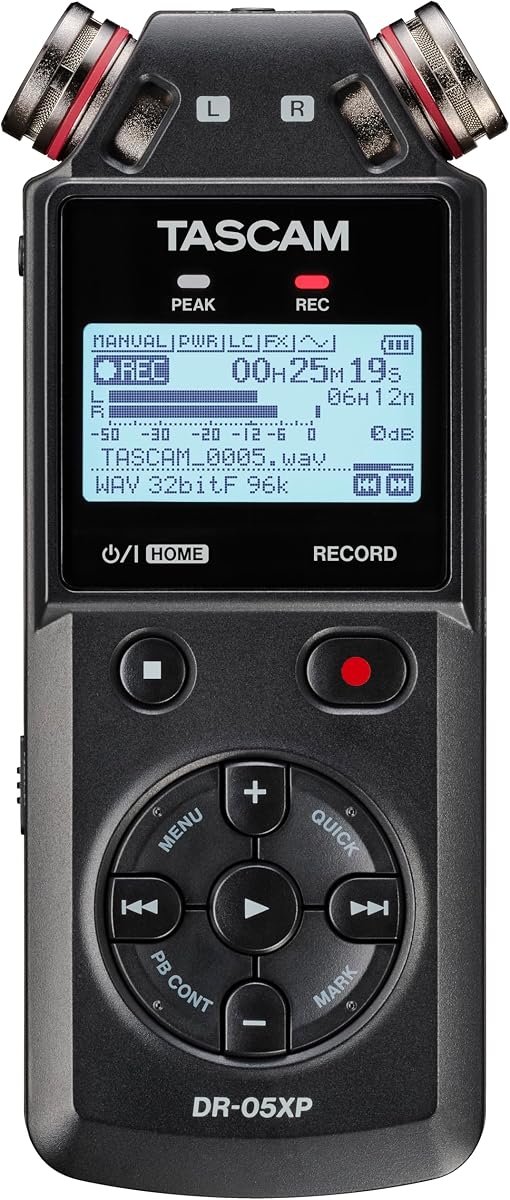
The TASCAM DR-05XP is a portable handheld recorder ideal for capturing music, voice, or video audio on the go. With a 4.2 rating, it provides flexible recording modes including 32-bit float for capturing dynamic audio without clipping.
We may earn a commission when you buy through this link, at no additional cost to you.
Its omnidirectional condenser microphones handle loud environments up to 125dB SPL, while the USB-C connection doubles as a computer audio interface. Running up to 17.5 hours on AA batteries ensures long operational time.
The lack of XLR inputs and stereo-only limitation may restrict film use needing mic flexibility. Still, its simplicity and low cost make it suitable for ambient sound or secondary audio capture tasks.
Users seeking a lightweight recorder for general audio tasks will appreciate the DR-05XP. It balances functionality with portability for everyday recording needs.
Direct computer connection for recording or streaming adds versatility beyond standalone field recording capabilities.
Up to 17.5 hours operation on AA batteries supports extended field use without frequent power changes.
We may earn a commission when you buy through this link, at no additional cost to you.
The Zoom H5 is a versatile 4-track handheld recorder known for its interchangeable input capsules that adapt to different recording needs. Its 4.7 rating reflects strong performance for filmmakers and musicians needing flexible audio capture.
We may earn a commission when you buy through this link, at no additional cost to you.
The included XYH-5 capsule offers shock-mounted microphones with reduced handling noise, while two mic/line inputs with XLR/TRS combo connectors provide external mic support. It also functions as a multichannel USB audio interface for PC or Mac.
Though it lacks timecode and is an older model compared to newer units, its modularity makes it a valuable tool for diverse recording scenarios. Battery power and direct SD card recording ensure reliability on location.
Creators wanting customizable mic setups will find the H5 highly adaptable. It balances traditional recording features with modern connectivity for broad use.
Swap input capsules like camera lenses to match different recording environments, enhancing versatility significantly.
Connect to computers for multichannel recording or streaming, expanding functionality beyond standalone recording.
We may earn a commission when you buy through this link, at no additional cost to you.
The TASCAM DR-10L Pro is a specialized field recorder designed for personal audio capture with a built-in lavalier microphone. With a 4.4 rating, it offers seamless timecode synchronization and 32-bit float recording for clear, lifelike audio.
We may earn a commission when you buy through this link, at no additional cost to you.
Its LTC Jam Sync ensures perfect audio-video sync, while wireless timecode support with the AK-BT1 adapter expands connectivity options. The included TM-10L lavalier mic delivers quality sound even in busy environments like weddings.
Limitations include single-channel recording and 512GB storage cap, restricting use for multi-mic setups. Still, its compact design and timecode features make it ideal for discreet interviews or solo vlogging.
Solo creators needing reliable personal audio with timecode will appreciate the DR-10L Pro. It simplifies high-quality recording in minimal space.
Seamless timecode synchronization simplifies multi-device setups and streamlines post-production for filmmakers.
The matched lavalier microphone delivers clear sound in busy settings, perfect for interviews or on-camera work.
We may earn a commission when you buy through this link, at no additional cost to you.
The Zoom H1 Essential is an entry-level recorder designed to help creators capture clear stereo audio for videos and podcasts. With a 4.0 rating, it prioritizes simplicity and portability, making it accessible for beginners.
We may earn a commission when you buy through this link, at no additional cost to you.
Its USB-C connection doubles as a microphone for livestreams or remote meetings, while its small size ensures easy transport. It captures real-world sound well for ambience, nature recordings, or everyday environment documentation.
The lack of XLR inputs and limited professional features restricts use for complex productions. However, its ease of use makes it perfect for content creators needing quick, quality audio without technical hurdles.
New creators seeking a straightforward tool will find the H1 Essential ideal. It removes barriers to better audio production for casual users.
Use as a microphone for livestreams or calls directly via USB-C, streamlining setup for creators.
Record ambience and nature sounds effectively, ideal for video projects needing authentic background audio.
We may earn a commission when you buy through this link, at no additional cost to you.
The Zoom F2 is the smallest wearable 32-bit float recorder available, perfect for discreet audio capture on interviews or vlogs. Its 4.0 rating highlights reliable performance without needing gain adjustments for any volume level.
We may earn a commission when you buy through this link, at no additional cost to you.
It includes the LMF-2 lavalier microphone and runs up to 15 hours on two AAA batteries, ensuring long recording time. The internal clock ensures perfect audio-video sync with +/-0.5ppm precision for professional production.
Being wearable limits it to single-source recording, and it lacks external input options. Still, its clip-free audio and simplicity make it valuable for journalists or creators needing unobtrusive sound capture.
Filmmakers needing a discreet, reliable personal recorder will appreciate the F2. It delivers professional audio in the smallest wearable form.
Captures clip-free audio at any volume, eliminating need for gain adjustments during critical shoots.
+-0.5ppm accuracy ensures perfect audio-video sync for professional film and video production.
We may earn a commission when you buy through this link, at no additional cost to you.
Selecting the right audio field recorder involves evaluating features that align with your production needs and budget. This section outlines key factors to consider.
Look for recorders supporting high-resolution formats like 24-bit/96kHz or 32-bit float. 32-bit float is particularly valuable because it captures dynamic range without clipping, reducing the need for gain adjustments on set.
Prioritize models with 32-bit float or at least 24-bit/96kHz to ensure your audio meets professional standards without distortion.
Consider the number of XLR inputs you need based on your typical setups. Simple interviews might only require two inputs, while multi-camera or complex scenes may demand four or more channels simultaneously.
Choose a recorder with enough XLR inputs to match your microphone count without needing additional mixers.
For professional film workflows, timecode synchronization ensures audio tracks align perfectly with video frames. Look for built-in timecode I/O or support for external timecode generators to streamline post-production editing.
Timecode support is critical if you work with multiple cameras or need frame-accurate audio sync in post.
Field recorders vary widely in size and weight, impacting how easily you can carry them on location. Compact handheld models suit solo shoots, while larger units offer more inputs at the cost of portability.
Balance the need for inputs against how much gear you can comfortably carry in the field.
Check battery life and whether the device supports external power sources like AA batteries or rechargeable packs. Long shoots require reliable power options to prevent interruptions during critical recording moments.
Opt for models with long battery life or flexible power options to ensure uninterrupted recording.
High-quality audio files consume significant storage space, so support for large-capacity SD cards is important. Some recorders support SDXC cards up to 1TB, allowing extended recording sessions without constant file management.
Ensure the recorder supports SDXC cards with enough capacity for your typical session lengths.
Features like USB-C connectivity, waveform displays, and built-in microphones add versatility for various workflows. Wireless timecode support or multichannel interface capabilities can expand your options for streaming or computer recording.
Prioritize features that align with your specific workflow needs beyond basic recording.
Budget constraints often influence decisions, but higher-end recorders offer reliability and features that justify their cost for professional work. Balance affordability against required capabilities to find the best long-term investment.
Evaluate total value considering features, durability, and resale potential rather than just upfront cost.
Begin by properly setting up your microphones and securing connections to prevent disconnections during recording. Always check audio levels and monitor waveform displays to avoid distortion or clipping on critical takes.
Store your recorder in a protective case when not in use and keep it away from extreme temperatures or moisture to preserve electronic components. Regularly update firmware to benefit from performance improvements and bug fixes.
Back up recordings to multiple storage devices immediately after shoots to prevent data loss. Clean input jacks and contacts occasionally to ensure reliable connections and maintain audio quality over time.
32-bit float recording captures audio with an extended dynamic range that prevents clipping even if levels spike unexpectedly. This technology allows you to adjust audio levels in post-production without quality loss, making it ideal for unpredictable environments.
Timecode synchronization is essential for professional film workflows where audio must align perfectly with video frames. While simple shoots may not need it, any multi-camera or post-heavy production benefits greatly from frame-accurate sync.
Many modern field recorders support USB-C connectivity that allows them to function as audio interfaces for computers. This flexibility enables live streaming, voiceovers, or studio recording without needing separate hardware.
Handheld models are portable and convenient for simple tasks or interviews, while dedicated field recorders offer more inputs and features for complex production. Consider your typical shoot needs and how many microphones you plan to use.
SD cards with high capacity and fast write speeds are recommended to handle high-resolution audio files. Ensure your recorder supports SDXC cards if you need storage beyond 32GB for extended recording sessions.
Using a recorder with built-in timecode or clapperboards helps maintain synchronization between audio and video. Some devices offer wireless timecode support for seamless alignment across multiple devices during production.
The Zoom F6, F3, and F8n Pro stand out as top choices offering professional-grade features tailored for filmmakers. Each balances capabilities and portability differently to suit various production scales and budgets.
Prioritize features like 32-bit float recording, sufficient inputs, and timecode based on your typical workflow complexity. The right recorder enhances sound quality and simplifies post-production significantly.
Keep in mind that availability and details can change, so always verify current specifications before purchasing. Invest wisely in a tool that supports your creative vision and technical requirements effectively.