
waveshare 2.4inch LCD Display Module
4.2Editor score
240×320 Resolution
SPI Interface Compatible
65K RGB Colors
LCD graphic displays are essential components for modern embedded systems and user interfaces. They provide clear visual feedback for data monitoring, control panels, and interactive applications across various industries including manufacturing and consumer electronics.
We compared ten leading models based on resolution, interface types, touch capabilities, and compatibility with popular microcontrollers like Arduino and ESP32. Our analysis focuses on real-world performance, driver support, and ease of integration for developers and hobbyists alike.
Each pick highlights specific strengths such as color accuracy, response speed, or cost efficiency. Please note that prices and availability may change frequently on retailer platforms, so verify current stock before making your final purchasing decision for your project needs.
4.2Editor score

3.8Editor score

4.2Editor score
As an Amazon Associate we earn from qualifying purchases.
This side-by-side comparison evaluates all ten selected LCD graphic displays across key technical specifications to help you identify the most suitable model for your specific application requirements.


The Thermalright Trofeo Vision LCD offers a stunning 6.86-inch full-color experience with a resolution of 1280×480. It stands out for its ability to show system parameters dynamically through TRCC software, making it ideal for enthusiasts who want visual monitoring on their PC cases.
We may earn a commission when you buy through this link, at no additional cost to you.
Its magnetic panel design allows for flexible positioning on compatible chassis or water cooling radiators. The IPS technology ensures stable viewing angles and true color restoration, which is rare in sub-displays for PC hardware.
While it offers high visual fidelity, the power and data rely entirely on a 9-pin USB interface from the motherboard. This means installation requires careful wiring confirmation before software setup to ensure stability.
Buy this if you want a premium visual upgrade for your PC build and need to monitor system stats directly on a screen. It balances customization with practical monitoring tools effectively.
The magnetic attraction allows free movement across the chassis without fixed positions, enhancing customization options for PC cases.
TRCC software enables downloading themes and switching between static or dynamic images for personalized system monitoring.
We may earn a commission when you buy through this link, at no additional cost to you.
This 7-inch display integrates an ESP32-S3 controller directly, offering powerful dual-core processing at 240MHz. It is designed for robust HMI and IoT applications where wireless connectivity and touch interaction are critical requirements.
We may earn a commission when you buy through this link, at no additional cost to you.
With support for Arduino IDE, PlatformIO, and MicroPython, it lowers the barrier for developers using the LVGL graphics library. The responsive touch operations enable intuitive user interface designs for complex industrial or home automation scenarios.
The module includes a TF card slot and various interfaces like USB and battery connections, though managing power can be complex for portable projects. The size makes it less suitable for compact embedded spaces.
Choose this for professional-grade smart home or medical equipment interfaces. It provides a complete ecosystem for developing advanced touch applications without needing external microcontrollers.
Integrated WiFi and Bluetooth provide robust connectivity for IoT devices without needing extra hardware modules.
Includes 16 tutorials and expert technical support to assist with troubleshooting and implementation challenges.
We may earn a commission when you buy through this link, at no additional cost to you.
The waveshare 2.4inch module is an economical choice for projects requiring a compact yet vivid display. It features an ILI9341 driver and delivers 65K RGB colors with a standard 240×320 resolution.
We may earn a commission when you buy through this link, at no additional cost to you.
Using a SPI interface minimizes the required IO pins on your controller board, making it easy to connect to Raspberry Pi or STM32 systems. It comes with development resources like examples to speed up integration.
While the display quality is clear, it is best suited for smaller projects due to its size limitations. It lacks touch functionality which might be needed for interactive apps.
Ideal for hobbyists or basic data visualization tasks where cost and simplicity are priorities. It delivers reliable performance without draining your budget or GPIO ports.
SPI bus usage reduces pin count, allowing more freedom to connect other sensors or components.
65K RGB colors provide vibrant visuals suitable for graphical user interfaces on embedded devices.
We may earn a commission when you buy through this link, at no additional cost to you.
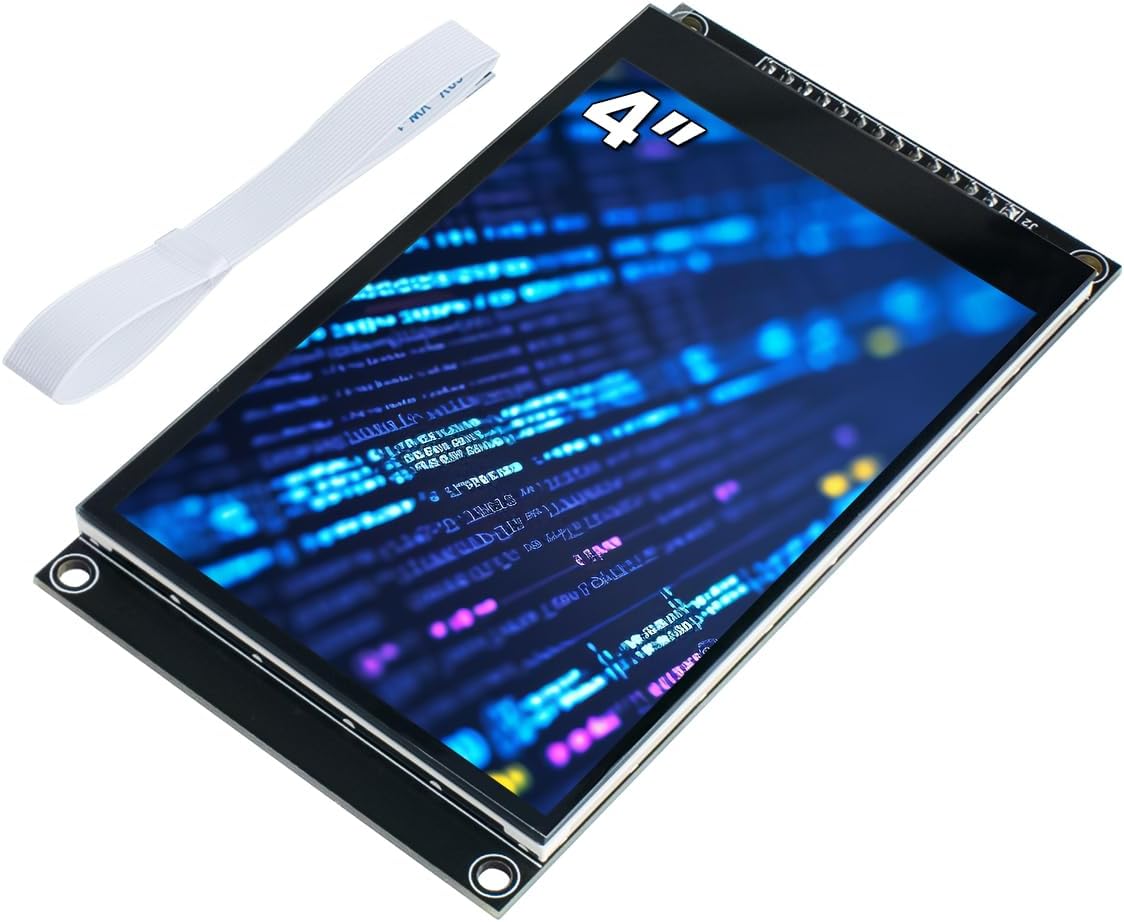
This 4.0-inch module upgrades to capacitive touch technology, offering better accuracy and convenience than resistive screens. It provides a 320×480 resolution with rich colors and a brightness of 300 cd/m2.
We may earn a commission when you buy through this link, at no additional cost to you.
The ST7796S driver supports both 5V and 3.3V MCUs via a 4-wire SPI bus, saving IO pins. It includes a TF card slot for easy storage expansion and supports various microcontrollers like ESP32 and Arduino.
The brightness and color depth make it suitable for outdoor or bright indoor environments. However, TN panels may have limited viewing angles compared to IPS alternatives.
Select this if you need a touch interface for a project that requires precise input without complex calibration. It balances features and cost effectively for mid-size displays.
Capacitive touch improves user experience with faster response times compared to traditional resistive options.
The onboard TF card slot allows storing assets or logs directly on the module hardware.
We may earn a commission when you buy through this link, at no additional cost to you.
Designed specifically for Arduino Mega2560, this 3.5-inch TFT display uses the ILI9486 driver to deliver 480×320 resolution. It features an onboard level conversion chip for 5V and 3.3V MCU compatibility.
We may earn a commission when you buy through this link, at no additional cost to you.
The 36 pins interface allows direct insertion into the Mega board, simplifying the setup process. It supports rich color display and is optimized for development boards in the Arduino series.
However, this screen does not include touch functionality, which limits its use in interactive projects. The 36 pins consume significant IO resources on the controller.
Best for non-interactive display tasks where you need high resolution on a Mega board. It offers plug-and-play convenience for visual data presentation.
Direct insertion into Mega2560 simplifies wiring and reduces the need for breadboards or breakout boards.
Compatible with both 3.3V and 5V operations to match various development board voltage standards.
We may earn a commission when you buy through this link, at no additional cost to you.
This kit combines a 5-inch touch screen with an ESP32-S3 core and a protective acrylic case. It runs at 240MHz with integrated WiFi and Bluetooth for robust performance in IoT applications.
We may earn a commission when you buy through this link, at no additional cost to you.
Development is flexible with support for Arduino IDE and MicroPython using the LVGL library. The case ensures a durable professional look right out of the box for consumer electronics.
While it offers solid specs, some users report variable touch responsiveness compared to premium models. It remains a strong contender for those wanting a complete package without extra hardware.
Ideal for smart home prototypes where a ready-to-use interface is preferred. The included tutorials make it accessible for developers of any skill level.
The acrylic case adds durability and protects the screen from damage during project assembly and use.
WiFi and Bluetooth enable wireless data transmission and control for smart device applications.
We may earn a commission when you buy through this link, at no additional cost to you.
These 3.12-inch OLED modules offer a high resolution of 256×64 with bright green font colors. The SSD1322 driver supports multiple communication methods including 8-bit parallel and SPI protocols.
We may earn a commission when you buy through this link, at no additional cost to you.
OLED technology provides clear content display with excellent contrast. The modules are sold in a pack of two, making them cost-effective for projects requiring multiple displays.
Soldering pins are required which adds to setup time. The smaller resolution limits complex UI designs but suits status indicators well.
Great for small projects needing vibrant text or simple graphics. They offer good clarity and contrast for low power visual feedback systems.
Supports various protocols like SPI and Parallel to fit different microcontroller pin constraints.
OLED technology offers better contrast ratios than LCD for clearer text visibility.
We may earn a commission when you buy through this link, at no additional cost to you.
This mini LCD module features an IPS screen with 240×320 resolution and ST7789V driver. It is designed for compact applications where space is limited but high color quality is needed.
We may earn a commission when you buy through this link, at no additional cost to you.
It requires minimal GPIOs for control and supports both 3.3V and 5V power supplies. The LED backlight and 262K colors ensure vibrant images even on a small screen.
Users must ensure power and logic voltages match to avoid issues. The small size limits detailed visualization tasks.
Perfect for wearable devices or compact instruments. It offers excellent color fidelity in a tiny footprint for embedded systems.
262K RGB colors provide vibrant visuals suitable for graphical user interfaces on embedded devices.
Small dimensions make it ideal for portable gadgets or wearables requiring efficient visual display.
We may earn a commission when you buy through this link, at no additional cost to you.
This 4-inch module offers 480×320 resolution with touch function and SPI interface support. It uses ST7796S driver and includes a pen and SD slot for expandability.
We may earn a commission when you buy through this link, at no additional cost to you.
Compatible with Arduino R3 and Mega controllers, it improves project operation with sample programs. The SPI bus minimizes IO usage while maintaining speed.
While touch works well, it may lack the precision of capacitive options. Resolution is limited compared to larger displays.
Choose for interactive learning projects with Arduino. It provides a balanced feature set for mid-size touch applications.
Rich sample programs and driver support accelerate development for new users learning embedded display control.
SD card slot allows for storing assets or logging data directly on the display module.
We may earn a commission when you buy through this link, at no additional cost to you.
This module features a FSTN transflective display with 240×128 pixels and a 20-pin connector. It is built for industrial use with strong visibility in varied lighting.
We may earn a commission when you buy through this link, at no additional cost to you.
The transflective technology works well in bright environments without needing high power backlights. It is suited for control panels and equipment requiring durable feedback.
It is more expensive than hobbyist modules and supports only grayscale visuals. Setup may require specific wiring expertise.
Ideal for industrial equipment panels needing reliable visual feedback. It prioritizes durability and visibility over color richness.
Transflective technology ensures visibility in outdoor or bright environments without high power consumption.
20-pin connector ensures stable industrial connections compatible with standard control systems.
We may earn a commission when you buy through this link, at no additional cost to you.
Selecting the right LCD graphic display involves balancing resolution, interface, and controller compatibility to match your project requirements.
Resolution determines the clarity of your visual output. Higher resolutions like 800×480 or 1280×480 are essential for detailed UI designs while 240×320 suffices for basic status displays.
Choose a size that fits your device enclosure. Small 2 to 3 inch modules save space but may limit text readability compared to larger 7 inch screens.
SPI interfaces save IO pins making them ideal for microcontrollers like Arduino or ESP32. Parallel interfaces offer faster data transfer but require more pins and complex wiring.
Verify your controller supports the interface. SPI is generally preferred for hobby projects due to simplicity and lower pin count requirements.
Touch screens add interactivity for HMI projects. Capacitive touch offers smoother interaction while resistive touch is more affordable and robust.
If your project needs buttons or navigation, ensure the touch support matches your software library compatibility.
Drivers like ILI9341 or ST7796S determine how the controller communicates with the panel. Check driver availability in your software ecosystem like Arduino IDE.
Matching the driver to your development environment reduces setup time and simplifies troubleshooting during implementation.
Modules often require specific voltage levels like 3.3V or 5V. Ensure your power supply matches these levels to prevent damage.
Consider battery usage for portable projects. Higher brightness and resolution increase power consumption significantly.
IPS panels offer better viewing angles and color accuracy than TN. OLED displays provide higher contrast and faster response times.
Choose based on your lighting conditions. Transflective displays are best for outdoor use where sunlight may affect visibility.
Some modules include controllers like ESP32-S3 for standalone operation. Others rely on external microcontrollers.
Decide if you need an integrated controller for wireless features or external flexibility.
Features like WiFi and Bluetooth allow wireless communication for IoT applications. USB-C connectors simplify wiring and power connections.
Check for additional slots like TF card storage to support asset management or logging tasks.
Always verify voltage compatibility before connecting power. Mismatched voltages can permanently damage the display driver and panel.
Clean the screen with a soft dry cloth. Avoid using liquids or harsh chemicals that could harm the surface coating.
For long term storage keep the module in a dry place. Cover exposed pins to prevent oxidation and ensure stable performance.
SPI uses fewer pins and is slower but easier to wire making it popular for microcontrollers. Parallel is faster but requires more pins which can complicate wiring and limit other component usage.
No many standard LCD modules are display only. Touch options require additional hardware layers like capacitive or resistive screens which add cost and complexity.
Yes many models including SPI based ones are compatible with Raspberry Pi. Check driver support in your operating system for smooth integration.
Use a protective case or acrylic cover. Avoid direct exposure to dust and moisture to maintain clear visibility and extend the lifespan.
300 cd/m2 is usually sufficient for indoor environments. Higher brightness is needed for outdoor or brightly lit spaces to ensure visibility.
Most models are designed for Arduino boards like Mega2560 or Uno. Check pin and voltage requirements before connecting to ensure compatibility.
Many include TF card slots or support SD cards for storing images or logs. This allows local data storage without external drives.
240×320 offers enough space for text and simple graphics. Higher resolutions are unnecessary for basic indicators unless detailed visualization is needed.
We explored ten versatile options from compact SPI modules to full HMI integrated systems. Each offers distinct benefits depending on your project needs and controller type.
Prioritize resolution and interface compatibility to avoid wiring issues. Consider power and size constraints for portable or embedded applications.
Always check current prices and stock availability as these vary frequently. Selecting the right display ensures a stable visual experience for your final product.