
Entina Tina2C 3D Printer
4.4Editor score
Auto leveling system
WiFi and offline mode
STEM learning modules
This guide compares the top 3D printer for educational use options for classrooms and home learning, evaluating speed, safety, and ease of use.
Finding the right 3D printer for educational use requires balancing speed, safety, and ease of setup. Schools and home educators need machines that minimize downtime while maximizing creative output for students of all ages.
We evaluated ten leading models based on their calibration ease, build quality, and safety features. Our analysis focuses on how well each printer supports STEM learning objectives without requiring constant technical oversight from teachers.
Each pick highlights specific strengths like multi-color printing or enclosed safety features. Please note that product availability and pricing can change frequently, so verify current details before purchasing your educational 3D printer.
4.4Editor score

4.7Editor score
4.7Editor score
The following table provides a side-by-side comparison of all ten models to help you quickly identify the best fit for your specific educational environment and project needs.



The Bambu Lab A1 stands out as a top choice for educational environments needing high performance with minimal setup time. Its rating reflects exceptional reliability and speed that keeps student engagement high during class projects.
We may earn a commission when you buy through this link, at no additional cost to you.
With acceleration of 10,000 mm/s², this printer delivers rapid results without sacrificing detail, making it ideal for iterative design exercises. The full-auto calibration ensures that every student gets consistent results regardless of experience level.
While the initial investment is higher, the reduction in maintenance time and waste makes it cost-effective over time. The quiet operation allows it to fit into libraries or quiet study zones without disruption.
Educators seeking a printer that balances speed, ease of use, and professional quality should consider this model for their STEM labs.
Fast printing means less waiting time and more opportunities for students to iterate on their designs during short class periods.
Automatic calibration reduces the likelihood of failed prints, ensuring teachers spend time teaching rather than troubleshooting hardware.
We may earn a commission when you buy through this link, at no additional cost to you.
The Entina Tina2C is designed specifically for younger students and beginners who need a hassle-free entry into 3D printing. Its low cost and quick setup make it accessible for home schooling or small classroom pilots.
We may earn a commission when you buy through this link, at no additional cost to you.
It comes fully assembled and includes a comprehensive app that offers AI-powered design tools and over 3000 ready-to-print models. This ecosystem encourages creativity without requiring advanced CAD knowledge.
While the print area is limited, it is sufficient for most educational prototypes and small parts. The compact design ensures it fits easily on desktops or lab benches without taking up excessive space.
For programs with limited budgets or space constraints, this mini printer provides a fun and educational experience that sparks interest in engineering and design.
The app allows students to turn ideas into models quickly using text or image inputs, fostering creativity and problem-solving skills.
Low noise levels and a compact build make it safe for home or classroom use without disrupting other activities.
We may earn a commission when you buy through this link, at no additional cost to you.
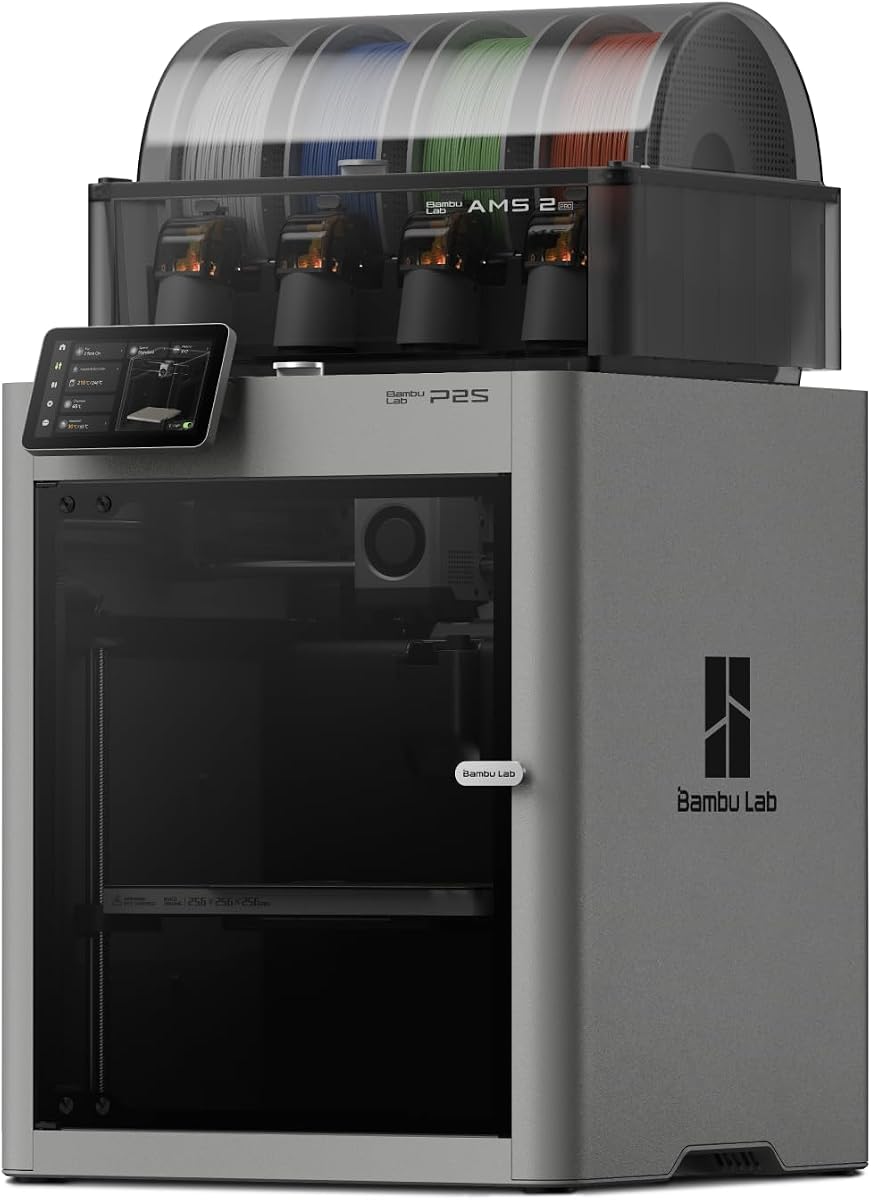
The Bambu Lab P2S Combo is an advanced option for educational programs looking to introduce multi-material and multi-color printing concepts. Its enclosed design supports a wider range of filaments for more complex engineering projects.
We may earn a commission when you buy through this link, at no additional cost to you.
With speeds up to 600 mm/s and adaptive airflow control, this printer handles everything from standard PLA to engineering-grade ABS and ASA reliably. The included AMS 2 Pro allows for vibrant, detailed prints that capture student attention.
While it comes at a premium price, the versatility it offers justifies the cost for advanced classrooms or makerspaces. The filament drying feature ensures consistent print quality by removing moisture before extrusion.
This model is ideal for schools aiming to provide industry-standard 3D printing capabilities that challenge students to explore advanced materials and designs.
The ability to print with multiple colors and materials in one go opens up new possibilities for realistic prototypes and artistic creations.
Fast speeds and smart airflow ensure consistent results even for large or complex prints, reducing wasted material and time.
We may earn a commission when you buy through this link, at no additional cost to you.
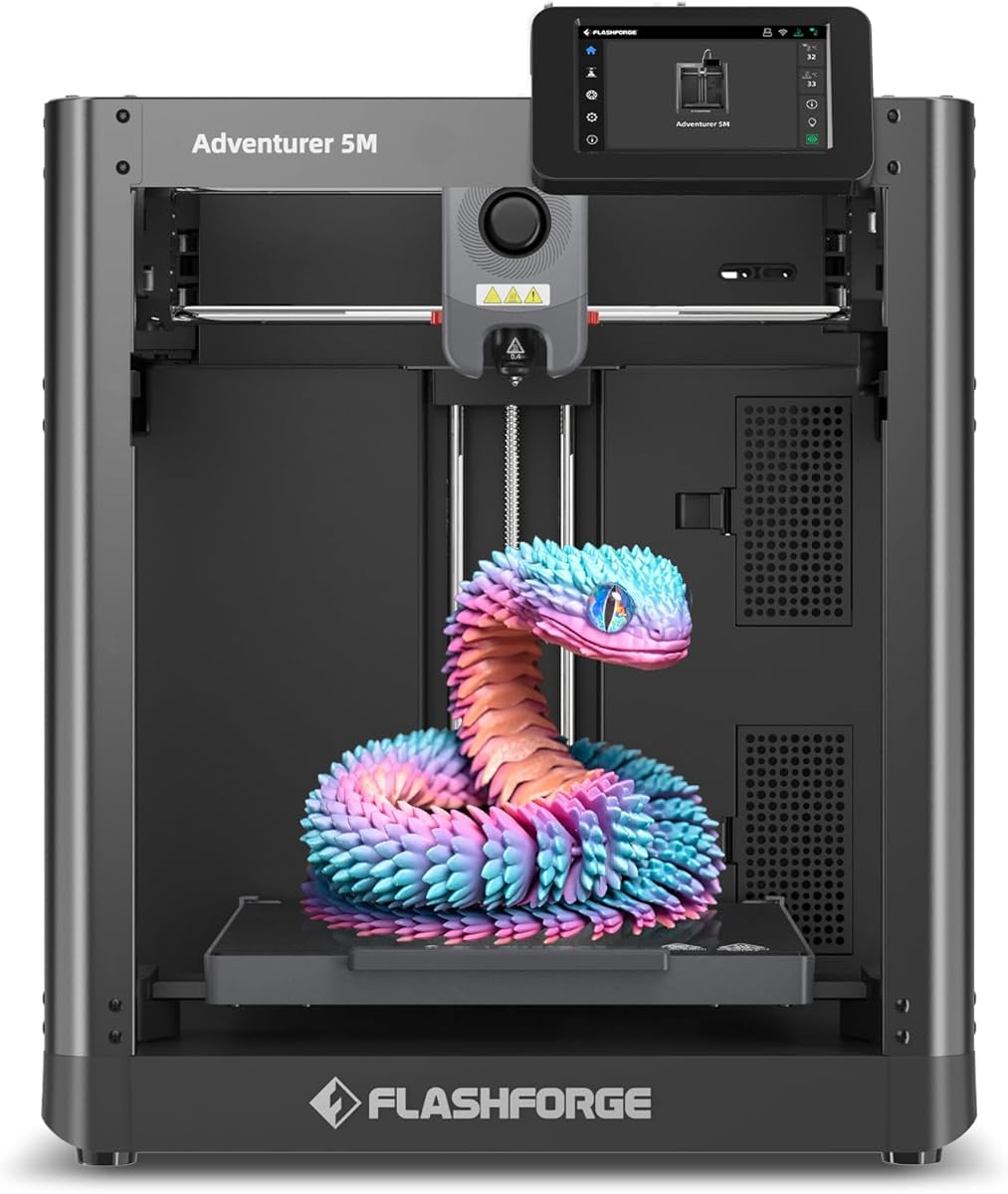
The FLASHFORGE Adventurer 5M offers impressive speed and mechanical robustness, making it suitable for environments where throughput is a priority. Its CoreXY structure and high-speed capabilities ensure rapid project completion.
We may earn a commission when you buy through this link, at no additional cost to you.
With a 280°C direct extruder and detachable nozzles, it supports a variety of materials and easy maintenance. This feature is beneficial for educational settings where different filaments may be tested frequently.
However, its open design may not be suitable for all materials, and some users report lower reliability compared to competitors. Proper ventilation is required when printing with certain polymers to avoid fume buildup.
For educators prioritizing speed and mechanical reliability over advanced safety features, this printer provides a strong platform for rapid prototyping and learning.
High speeds allow for multiple iterations in a single class period, encouraging rapid design thinking and testing.
The all-metal structure and CoreXY system provide stability and durability for frequent use in a school environment.
We may earn a commission when you buy through this link, at no additional cost to you.
The FLASHFORGE AD5M builds on the speed of the Adventurer series with a focus on user-friendly maintenance and precision. Its one-click auto leveling ensures students can start printing immediately after setup.
We may earn a commission when you buy through this link, at no additional cost to you.
The quick-swap nozzle feature simplifies maintenance, allowing for rapid changes between different nozzle sizes without tools. This flexibility is valuable in educational settings where print precision needs to vary.
Power loss recovery ensures that interrupted prints can resume, saving material and effort during busy class schedules. The open design, however, requires proper room ventilation for safe operation.
This model is well-suited for classrooms that need a balance of speed, precision, and reliable performance without excessive maintenance overhead.
The combination of CoreXY motion and auto calibration provides the accuracy needed for detailed educational projects.
Tool-free nozzle changes reduce downtime and allow teachers to focus on instruction rather than printer upkeep.
We may earn a commission when you buy through this link, at no additional cost to you.
The Bambu Lab P1S offers a fully enclosed build chamber, which is a critical safety feature for schools handling high-temperature filaments. This design supports a wider range of materials without the risk of warping.
We may earn a commission when you buy through this link, at no additional cost to you.
Its fast setup and auto leveling make it easy to integrate into any curriculum, while high speeds ensure timely project completion. The ability to support multi-color printing adds another layer of creativity for students.
While it is a premium model, the enclosed design provides peace of mind regarding safety and material versatility. This makes it ideal for environments where various plastic types are used for different engineering challenges.
For educators prioritizing safety and material flexibility, the P1S provides a robust and reliable 3D printing solution.
The enclosed chamber protects students from hot parts and contains fumes, making it safer for indoor educational use.
The enclosed environment allows for printing with materials that are difficult to manage on open-frame printers.
We may earn a commission when you buy through this link, at no additional cost to you.
The Ugee Funbox is uniquely designed with child safety as a top priority, featuring UL GREENGUARD certification and a fully enclosed, cool-touch exterior. It is an ideal choice for introducing younger children to 3D printing.
We may earn a commission when you buy through this link, at no additional cost to you.
Its zero-calibration setup and vast library of pre-tested toy models make it easy for kids to print independently. The integrated AI tools allow children to generate models from text or images with minimal input.
Although it is limited to single-color printing, the focus is on safety and ease of use rather than advanced technical features. This makes it a safe option for home or younger grade school use.
For elementary educators or parents wanting a safe and fun introduction to STEM, the Funbox is a standout choice.
Anti-pinch doors and cool-touch surfaces ensure that children can interact with the printer without risk of burns.
With thousands of ready-to-print models and easy app control, kids can explore 3D printing without constant adult help.
We may earn a commission when you buy through this link, at no additional cost to you.
The upgraded version of the Adventurer 5M focuses on improving print reliability and support for flexible filaments. The dual-sided PEI plate and direct drive extruder make it easier to handle TPU and other specialty materials.
We may earn a commission when you buy through this link, at no additional cost to you.
Features like filament run-out sensors and power loss recovery ensure that projects are less likely to fail due to external issues. This reliability is key for classroom environments where materials can be wasted easily.
While it shares the open-frame design of previous models, these upgrades provide a more stable experience for educators looking to teach a broader range of materials. It remains a solid choice for budget-conscious schools.
This model is recommended for programs that need to print with flexible materials without a significant price jump.
The direct drive system allows for successful printing of flexible filaments, opening up new design possibilities.
Sensors for filament and power ensure that prints are saved, reducing the need to restart projects and waste materials.
We may earn a commission when you buy through this link, at no additional cost to you.
The Snapmaker U1 stands out with its unique toolhead system that allows for true multi-material and multi-color printing without complex setups. Its 5-second tool change mechanism minimizes waste and time during complex projects.
We may earn a commission when you buy through this link, at no additional cost to you.
This printer is designed for advanced educational programs that want to demonstrate real-world manufacturing concepts. The rigid CoreXY motion system ensures precision even during high-speed operations.
While the cost and complexity may be high for elementary students, it is an excellent tool for high school or vocational training. It supports a wide range of engineering materials and design requirements.
For makerspaces focused on advanced prototyping and multi-material designs, the Snapmaker U1 is a powerful educational tool.
The tool swapping system teaches students about multi-step processes and material integration in real-world manufacturing.
The robust locking mechanism and CoreXY design ensure the printer can handle high volumes of printing in a lab setting.
We may earn a commission when you buy through this link, at no additional cost to you.
The Bambu Lab A1 Mini Combo brings the speed and ease of the A1 series into a compact form factor. It is ideal for smaller classrooms or desks where space is a limiting factor.
We may earn a commission when you buy through this link, at no additional cost to you.
Despite its size, it offers the same rapid calibration and multi-color capabilities as its larger counterpart. This allows for detailed and colorful prints without taking up a large footprint.
While the build volume is limited, it is sufficient for most educational prototypes and small projects. The quiet operation and quick setup make it a reliable choice for daily use.
This printer is recommended for schools needing high performance in a tight space.
The compact design allows schools to deploy multiple printers in a single room to accommodate more students simultaneously.
The included AMS lite allows students to create vibrant multi-color prints despite the smaller build area.
We may earn a commission when you buy through this link, at no additional cost to you.
Selecting a 3D printer for educational use requires careful consideration of several factors to ensure it meets the needs of your students and curriculum effectively.
For educational environments, safety is paramount. Enclosed printers provide a barrier between students and hot parts, reducing the risk of burns. They also help contain emissions, which is crucial for classrooms without specialized ventilation.
Look for models with certified low-emission materials and enclosed chambers to ensure a safe learning environment.
Time is limited in educational settings, so a printer that requires minimal setup is essential. Automatic leveling and auto-calibration features reduce the technical burden on teachers and ensure consistent results.
Prioritize printers that offer one-click calibration to maximize time spent on learning rather than troubleshooting.
The size of the build area should match the typical project sizes in your curriculum. Faster print speeds mean more iterations can be completed in a single class period, keeping students engaged.
Choose a printer with a balance of sufficient build volume and rapid speeds to accommodate various project needs.
Different projects require different materials. Ensure the printer can handle the range of filaments you plan to use, such as PLA for beginners or PETG and TPU for more advanced students.
A printer with a versatile extruder system will support a wider range of learning activities.
Strong software support and a large community of users can significantly enhance the educational experience. Look for printers that offer intuitive slicing software and access to pre-built models.
A supportive community provides resources and troubleshooting help, making the learning curve smoother.
Classroom printers must withstand frequent use by multiple students. Durable construction and easy maintenance features, such as quick-swap nozzles, ensure the printer remains operational over time.
Invest in a model with robust mechanical parts to minimize downtime and repair costs.
While higher-end models offer advanced features, budget constraints may limit your options. Balance the cost with the necessary features for your specific curriculum to ensure value.
Consider the total cost of ownership, including filament and maintenance, not just the initial purchase price.
Begin by properly leveling the print bed and loading the first filament according to the manufacturer's instructions. Ensure the room is well-ventilated and the printer is on a stable, flat surface.
Monitor the first few prints closely to verify settings and bed adhesion. Clean the build plate regularly and check for any worn nozzles or clogs that might affect print quality.
After each use, allow the printer to cool down completely before covering or storing it. Keep a log of print times and material usage to help manage budgets and maintenance schedules.
Yes, many modern 3D printers designed for education are safe. Look for models with enclosed chambers, certified low emissions, and cool-touch exteriors to ensure student safety. Always follow manufacturer guidelines and supervise use.
Modern educational 3D printers are designed for ease of use. Many feature automatic leveling and calibration that can be completed in minutes. Look for models that are fully assembled and ready to print out of the box.
PLA is the most common and safest material for beginners. It is biodegradable and does not require high temperatures. For advanced projects, PETG and TPU offer more durability and flexibility.
Space requirements vary by model. Mini printers can fit on a desk, while larger units need a dedicated table or counter. Ensure there is enough clearance for ventilation and filament spools.
Yes, many models support remote monitoring via apps. This allows teachers or parents to track progress and control the printer from another device. It is a great feature for home schooling or hybrid environments.
With proper maintenance, an educational 3D printer can last several years. Regular nozzle cleaning, bed leveling, and part replacements will keep it running efficiently. Quality construction plays a major role in longevity.
Choosing the right 3D printer for educational use depends on your specific goals, budget, and the age of your students. Whether you need a simple mini printer for kids or a high-speed machine for advanced prototyping, there is a solution available.
Prioritize safety, ease of use, and reliability when making your selection. A printer that is easy to manage will allow educators to focus on teaching concepts rather than fixing hardware issues.
Remember to check current prices and availability as they can change frequently. Investing in the right tool will empower students to explore creativity and innovation through the power of 3D printing.