
6-Band Signal Generator
4.5Editor score
150 MHz max range
Low phase noise
6 frequency bands
This guide compares the top ten Amfm Signal Generator models available in October 2026 based on performance features frequency range and modulation capabilities
Finding the right signal generator is crucial for testing electronic circuits and communication systems effectively. Professionals need devices that offer precise frequency control and reliable modulation options like AM and FM for accurate results.
We evaluated ten top models based on their technical specifications frequency ranges and user feedback. This list includes handheld units for field work and benchtop devices for lab environments to suit various testing needs.
Each pick highlights key features and ideal use cases to help you choose quickly. Note that availability and pricing fluctuate so check current listings before purchasing to ensure you get the best deal available.
4.5Editor score

5.0Editor score

5.0Editor score
Here is a side-by-side look at the specifications and key features of all ten models to help you compare their capabilities and find the one that fits your specific technical requirements best.




The UNI-T UTG962E stands out as a top choice for users needing reliable RF and arbitrary waveform generation. With a perfect rating from users it delivers consistent performance in both lab and field settings.
We may earn a commission when you buy through this link, at no additional cost to you.
Its 60 MHz frequency range and dual channel output allow for versatile testing scenarios including AM FM and PM modulation. The compact size makes it easy to carry for on site diagnostics.
Some users note that the menu system can be intricate for beginners but the included USB connectivity simplifies data transfer. The memory depth supports storing multiple waveforms for repeated tests.
Buy this if you need a robust handheld unit that balances portability with high-end specs. It is ideal for electronics enthusiasts and professionals who demand precision without benchtop bulk.
The device combines palm sized dimensions with 60 MHz output capabilities allowing users to take lab grade testing anywhere without sacrificing signal quality or stability.
Support for AM FM PM and FSK modulation ensures this generator can handle diverse communication testing needs from simple sine waves to complex signal analysis tasks.
We may earn a commission when you buy through this link, at no additional cost to you.
The OWON DGE2035 offers a solid balance of features for educational and light industrial use. Its dual channel design and high resolution make it suitable for precise waveform generation tasks.
We may earn a commission when you buy through this link, at no additional cost to you.
Users appreciate the 3.6 TFT display for viewing real-time settings and waveforms. PC control via USB allows for remote operation which is great for automated testing setups.
While the frequency cap at 35 MHz limits high RF applications it remains strong for audio and lower frequency electronics. The built-in arbitrary waveforms reduce the need for custom uploads.
Choose this for labs needing reliable dual channel output without excessive cost. It is well suited for training environments where ease of use and visual feedback are priorities.
The large TFT color screen provides clear visibility of settings and waveforms making it easier for users to monitor parameters during complex testing sessions.
PC control through USB enables integration into larger test systems allowing operators to automate signal generation sequences for efficient workflow management.
We may earn a commission when you buy through this link, at no additional cost to you.
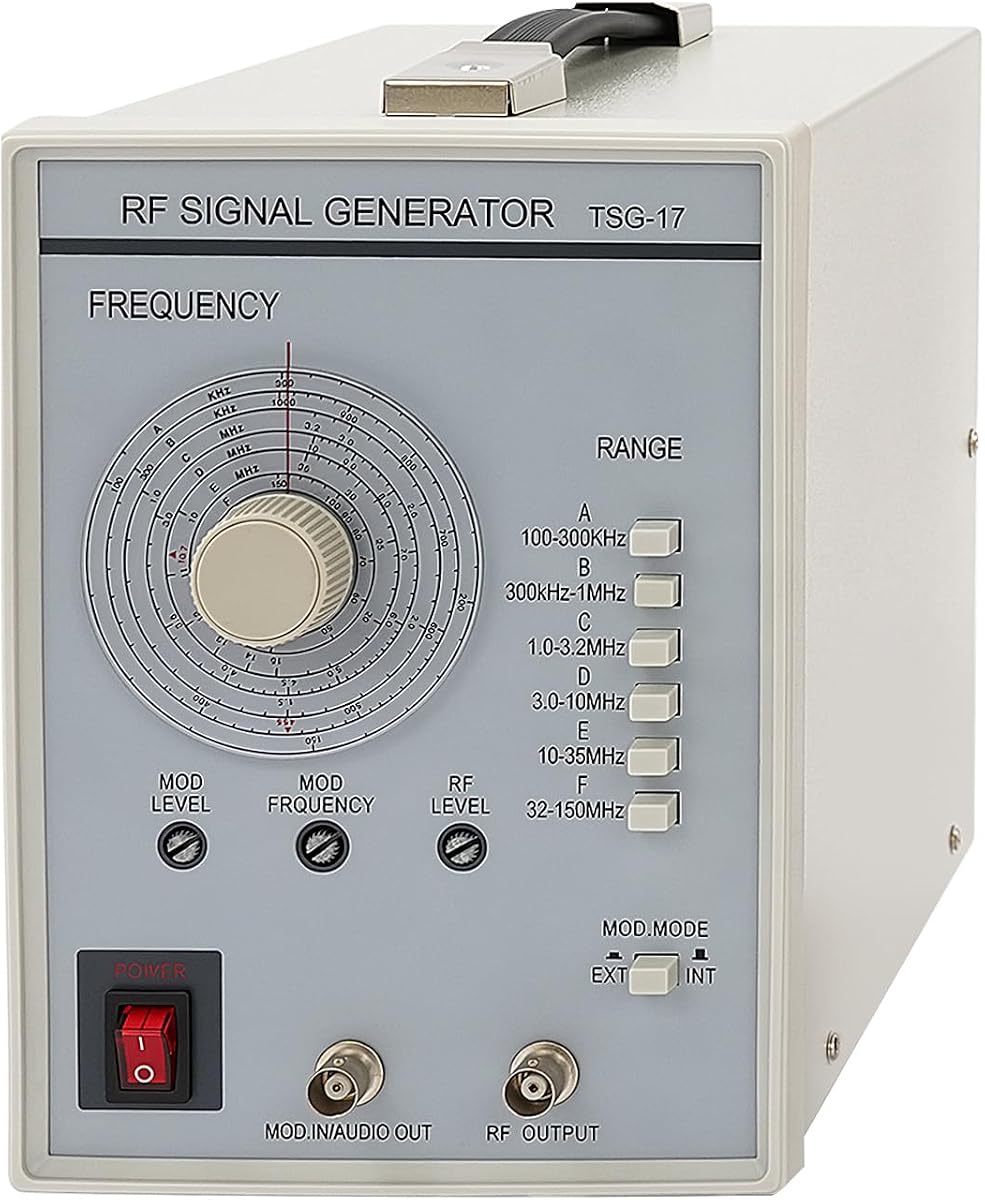
This 6-Band Signal Generator delivers impressive performance for its low price point. It is designed for maintenance and radio testing where clean signals are required without spending a fortune.
We may earn a commission when you buy through this link, at no additional cost to you.
The low phase noise ensures signal purity which is critical for accurate testing in sensitive electronic environments. The 6 band design covers a wide range from 100KHz to 150MHz.
Build quality is solid with metal components ensuring durability on the workbench. However it lacks advanced features like arbitrary waveform storage or PC connectivity found in pricier models.
Get this if you need a simple and clean RF signal source for general maintenance. It offers excellent value for hobbyists or technicians working on radio and low frequency circuits.
Engineered with low phase noise characteristics this generator produces pure signals that minimize interference and ensure reliable testing results for sensitive electronic components.
Its budget friendly price combined with a sturdy metal frame makes it an ideal investment for routine equipment maintenance and repair work in small workshops.
We may earn a commission when you buy through this link, at no additional cost to you.
The SG-A9 offers access to microwave frequencies up to 4400MHz at an accessible price. It is useful for testing higher frequency RF components where standard generators fall short.
We may earn a commission when you buy through this link, at no additional cost to you.
Memory retention ensures settings are saved after power loss which is convenient for field work. The sweep mode helps identify resonance points in antennas and transmission lines.
Users report mixed experiences on build quality and waveform purity. It is best used for qualitative checks rather than precision measurements where strict standards are required.
Consider this if you need coverage into the GHz range on a tight budget. It serves well for hobbyist projects and rough diagnostics but may lack refinement for professional labs.
Supporting frequencies up to 4400MHz allows users to test microwave circuits and antennas that are beyond the reach of standard HF or VHF signal generators.
Power off memory and USB port operation make this unit easy to use in the field without needing a dedicated bench power supply for every session.
We may earn a commission when you buy through this link, at no additional cost to you.
The TSG-17 provides a classic RF signal generation experience for legacy radio equipment. Its harmonic output supports testing circuits that rely on specific signal harmonics for functionality.
We may earn a commission when you buy through this link, at no additional cost to you.
External modulation allows users to input custom signals for testing AM receivers. The frequency range covers standard broadcast bands which is useful for consumer electronics repair.
Reliability concerns have been noted by some users regarding stability over time. It is better suited for short term testing rather than continuous operation in demanding environments.
Choose this for basic radio tuning and repair tasks where advanced waveform generation is not needed. It works as a dedicated tool for specific analog radio maintenance jobs.
Three harmonic outputs enable testing of circuits that require specific multiples of the fundamental frequency for proper operation in legacy radio designs.
Ability to accept external modulation signals makes this unit flexible for testing AM receivers against custom input patterns without requiring internal complex controls.
We may earn a commission when you buy through this link, at no additional cost to you.
This unit specializes in process control signal generation rather than high frequency RF. It is perfect for calibrating PLC inputs and industrial sensors using standard current and voltage loops.
We may earn a commission when you buy through this link, at no additional cost to you.
The built-in battery ensures operation during shutdowns or remote site visits. Voltage and current outputs can be set independently allowing for versatile testing of transmitters and actuators.
PWM output adds value for testing motor speed controllers. While not a pure AM FM generator it fulfills the signal needs for automation and industrial maintenance tasks effectively.
Buy this for industrial automation calibration where current loops are standard. It simplifies troubleshooting control panels without needing expensive multi-function instrumentation.
Designed specifically for 4-20mA and 0-10V standards this device streamlines the calibration of industrial sensors and PLC inputs during maintenance routines.
Rechargeable battery operation and short circuit protection ensure safe and reliable field use without risking damage to sensitive control equipment.
We may earn a commission when you buy through this link, at no additional cost to you.
The Riiai SG003A is a precise handheld tool for industrial signal simulation. It allows quick switching between voltage and current modes which speeds up troubleshooting in control panels.
We may earn a commission when you buy through this link, at no additional cost to you.
A large 4-digit display ensures values are readable even in low light conditions. The ability to store nine preset points makes it convenient for repeated testing sequences.
It lacks RF modulation capabilities so it serves as a specialized DC generator. For automation techs this precision and speed save valuable time during system maintenance.
Select this for high accuracy industrial calibration where reliability is key. It is an excellent choice for maintaining and troubleshooting modern control systems and sensors.
With precision up to 0.01V and 0.01mA this generator ensures that control systems are calibrated to exact standards for reliable operation.
Battery power and preset storage enable technicians to work faster on site by recalling common calibration points without manual re-entry.
We may earn a commission when you buy through this link, at no additional cost to you.
The DROK generator offers a straightforward approach to analog signal testing. Its single knob design makes adjusting voltage or current intuitive for users of all experience levels.
We may earn a commission when you buy through this link, at no additional cost to you.
It serves well for simple panel checks and LED testing where high precision isn't required. The compact size fits easily into tool bags for quick on-the-fly adjustments.
While it lacks digital memory features it remains reliable for basic analog tasks. It is an ideal entry point for those new to industrial electronics maintenance.
Choose this for budget-conscious users needing basic analog output. It works well for quick checks and simple simulations in workshops or small maintenance teams.
The single knob adjustment mechanism simplifies the process of changing signal values reducing the chance of user error during routine maintenance tasks.
Despite lacking advanced features it provides the essential voltage and current signals needed to test basic control loops and indicator lights effectively.
We may earn a commission when you buy through this link, at no additional cost to you.
The SEESII Dual Channel offers top-tier precision with independent control of two signal outputs. This is critical for testing differential circuits where phase alignment matters.
We may earn a commission when you buy through this link, at no additional cost to you.
With 60 built-in arbitrary waveforms it supports complex simulations without external software. The high sampling rate ensures clean signals for high fidelity testing applications.
The unit is a 7-in-1 instrument combining multiple tools which saves space on the workbench. While expensive it justifies cost with lab-grade accuracy and flexibility.
Buy this for advanced engineering R&D or educational labs. It provides the features needed for rigorous testing and complex circuit validation with superior accuracy.
Independent channel control with adjustable phase difference allows for precise testing of balanced circuits that require exact signal alignment.
Integrating function generation counting and sweeping into one device reduces the need for multiple tools and streamlines complex engineering workflows.
We may earn a commission when you buy through this link, at no additional cost to you.
This generator stands out with its ability to display real-time curve changes on a color screen. It is perfect for monitoring how signals affect systems during testing.
We may earn a commission when you buy through this link, at no additional cost to you.
Multiple signal types including voltage current and frequency provide broad coverage for various industrial protocols. Programmable output modes like rise fall and cycle add automation capability.
While it lacks RF modulation it covers most analog industrial needs comprehensively. The color interface helps visualize data quickly without external logging equipment.
Get this for complex PLC testing where visual feedback is valuable. It is a robust tool for maintenance teams needing to verify signal stability over time.
Real-time curve displays allow operators to watch signal changes instantly making it easier to identify faults or drift during active system checks.
Programmable output modes let users set automatic signal changes which reduces manual intervention and supports repeatable testing procedures.
We may earn a commission when you buy through this link, at no additional cost to you.
Selecting the right generator depends on your specific application needs whether for RF testing or industrial control signals. Understanding key technical factors ensures you get the best fit for your workflow.
Frequency range dictates the signals your generator can produce. For RF work ensure it covers the bands you need such as HF VHF or UHF. Lower frequency tools suffice for audio or industrial testing.
Always match the range to your target components to avoid limitations during critical testing phases.
AM FM and PM modulation are essential for communication testing. Verify that the device supports the types you need. Some budget models may only offer basic amplitude modulation.
Choose a model that supports the modulation schemes required by your specific circuit or protocol to ensure accurate signal simulation.
Dual channel outputs allow you to generate two different signals simultaneously. This is useful for differential circuit testing or comparing signal paths. Single channel units are simpler but less versatile.
Opt for dual channels if your work involves comparing inputs or requires independent signal streams for complex analysis.
Arbitrary waveform support lets you create custom signals beyond standard sine or square waves. This is vital for simulation and advanced testing. Ensure memory depth is sufficient for your patterns.
Look for built-in arbitrary waveforms or easy upload options to simplify custom signal creation.
Consider where you will use the generator. Handheld battery powered units are best for fieldwork while benchtop units offer stability for labs. Check battery life if mobile use is frequent.
Choose a power source that matches your typical environment to ensure uninterrupted testing sessions.
A clear display like an LCD or TFT helps in monitoring settings. Physical buttons are faster for quick changes while touchscreens offer more visual control. Look for intuitive layouts.
Prioritize interfaces that match your workflow to reduce setup time during testing.
USB or PC connectivity allows for remote control and data logging. This is beneficial for automated test setups. Check for standard ports that match your computer.
Ensure connectivity features align with your automation needs if you plan to integrate with other software.
Build quality affects lifespan especially in field environments. Metal cases resist damage better than plastic. Check for protection against short circuits or overloads for safety.
Invest in a sturdy build if the device will face regular transport or harsh working conditions.
Start by connecting the generator to a proper power source or charging the battery if portable. Allow the unit to warm up for a few minutes before starting tests to ensure stable output.
Use the appropriate cables such as BNC for RF or terminal blocks for industrial signals. Connect the output to your device under test and verify connections match impedance requirements.
Clean the device with a dry cloth and store it in a cool dry place. Avoid exposing it to extreme temperatures or moisture to maintain accuracy and extend its useful life.
RF generators focus on high frequency signals usually above 100KHz often for radio testing. Arbitrary waveform generators allow custom signal shapes which are useful for digital or complex circuit simulations.
For simple single circuit tests a single channel is enough. Dual channels are needed when comparing two inputs or testing differential circuits where both signals matter.
Yes models with lower frequency ranges down to audio levels can test speakers and amplifiers. Ensure the output amplitude matches audio equipment requirements to prevent damage.
Modulation like AM or FM is essential if you are testing radio receivers. For basic logic or power testing it might not be needed but offers greater flexibility for communication tasks.
Handheld units typically last 4 to 10 hours depending on usage. Look for rechargeable models with USB charging for convenience during long field work sessions.
PC control is useful for automated labs or recording data. If you test manually on site it is not essential but adds value for complex or repeated testing sequences.
The top picks cover a range of needs from budget hobbyist options to premium dual channel lab units. Each model offers distinct strengths depending on your focus on RF or industrial signals.
Prioritize frequency range and modulation support to match your specific testing requirements. Consider portability and connectivity to ensure the unit fits your working environment seamlessly.
Prices and availability change regularly so verify current details before purchasing. Investing in the right tool will improve accuracy and efficiency in your electronic testing projects.