
ESP32-S3-Nano Microcontroller Board
5.0Editor score
Integrated 16MB Flash memory
Switches between Arduino and MicroPython
Compact design with Wi-Fi Bluetooth
This guide compares the top Arduino Nano ESP32 boards and similar microcontrollers for IoT, wireless connectivity, and embedded projects in October 2026.
Choosing the right microcontroller for your next project can be challenging especially when wireless connectivity and processing power matter. The Arduino Nano ESP32 and its alternatives offer compact designs with Wi-Fi and Bluetooth capabilities ideal for modern IoT applications.
We evaluated ten top-rated boards based on processor performance, connectivity options, memory, and ease of use. Our analysis focuses on real-world usability for hobbyists engineers and professionals looking to build reliable connected devices without compromising on features.
Each pick highlights unique strengths from budget-friendly options to premium boards with advanced interfaces. Prices and availability may change so verify details before purchasing. These selections represent the best value and performance currently available in the market.
5.0Editor score

4.6Editor score

4.7Editor score
This table provides a side-by-side comparison of all ten boards covering key specifications like processor type, wireless standards, memory, and unique features to help you make an informed decision quickly.


The Arduino Nano ESP32 stands out as the premier choice for developers needing a balance of power and connectivity. With a 4.6-star rating it delivers excellent performance for IoT projects. The ESP32-S3 chip ensures fast processing while USB-C simplifies daily use.
We may earn a commission when you buy through this link, at no additional cost to you.
Its comprehensive wireless connectivity supports Wi-Fi and Bluetooth 5.0 for seamless data transfer. The MicroPython compatibility makes it accessible for Python developers. HID support allows custom input devices like mice or keyboards which is unique in this category.
While the price is slightly higher than generic boards the official support and quality justify the cost. The limited GPIO pins are acceptable for most small projects but large arrays may require expansion modules or alternative solutions for complex needs.
Ideal for students and professionals building smart home systems or wearables. The combination of high-speed processing and modern connectivity makes it a future-proof investment for advanced embedded applications requiring reliability and ease of use.
The USB-C port ensures stable power delivery and faster programming compared to older micro-USB standards common in legacy Arduino boards.
Compatibility with MicroPython allows rapid prototyping and easier scripting for developers who prefer Python over traditional C++ environments.
We may earn a commission when you buy through this link, at no additional cost to you.
This board offers incredible value for budget-conscious makers seeking high performance. With a perfect 5.0-star rating it excels in reliability. The onboard 16MB Flash provides ample storage for complex projects without external memory dependencies.
We may earn a commission when you buy through this link, at no additional cost to you.
Seamless switching between Arduino and MicroPython offers flexibility for different coding preferences. IoT Cloud support enables remote monitoring effortlessly. HID support makes it versatile for custom peripheral projects without additional hardware.
The size is slightly larger than thumb-sized options which may limit wearable applications. Documentation varies compared to official Arduino products but the community support compensates. Its cost efficiency remains unmatched for feature-packed ESP32-S3 boards.
Recommended for students or hobbyists needing robust features without breaking the bank. The combination of high memory and dual-language support makes it suitable for prototyping and small-scale production runs efficiently.
The integrated 16MB Flash allows storing more code and assets without needing external SPI flash chips.
Native compatibility with Arduino IoT Cloud simplifies device management and remote access for connected applications.
We may earn a commission when you buy through this link, at no additional cost to you.
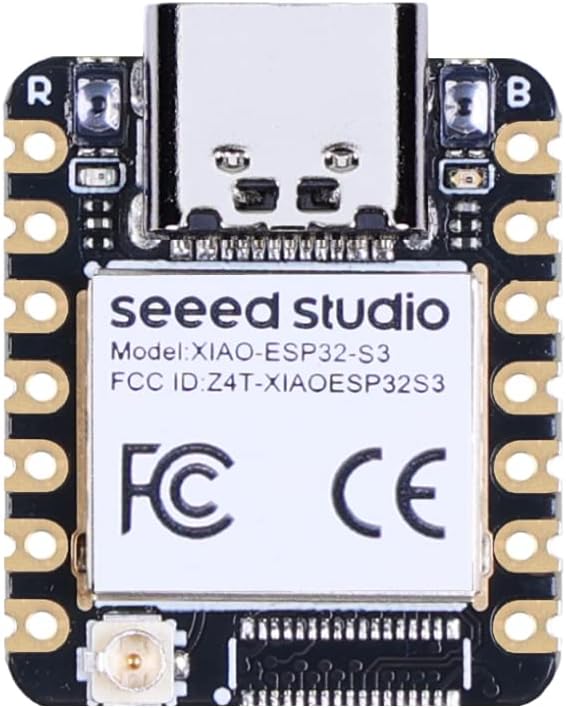
Designed for space-constrained projects this board combines power with a tiny footprint. Its 4.7-star rating reflects reliability in real-world wearables. The battery charge management simplifies portable device construction significantly.
We may earn a commission when you buy through this link, at no additional cost to you.
Power efficiency is remarkable with deep sleep modes consuming just 14 microamps. The U.FL antenna connector extends range beyond standard modules. Rich interfaces support diverse sensors without external adapters.
Users often note that breaking out pins requires care due to small size. It lacks direct USB on the back requiring a host for programming. These trade-offs are acceptable given the size and power benefits.
Perfect for wearable tech or robotics where weight matters. The compact design and battery support make it ideal for portable IoT solutions requiring long-term autonomy and minimal physical footprint.
Its thumb-sized design and low power consumption allow comfortable integration into wearable devices without bulk.
Support for U.FL antennas enables remote communication beyond 100 meters when using external antennas.
We may earn a commission when you buy through this link, at no additional cost to you.
This board targets advanced users needing high-speed image processing. A 4.8-star rating highlights its performance capabilities. The RISC-V dual-core processor offers efficient computing for complex algorithms.
We may earn a commission when you buy through this link, at no additional cost to you.
MIPI interfaces enable high-quality display connections. Image signal processors support JPEG and H264 encoding. Security features like secure boot protect sensitive data in industrial applications.
Beginners might find the interface set complex without prior experience. Documentation is specialized for hardware developers. These challenges are manageable for teams needing edge AI or video analytics.
Ideal for robotics or industrial automation requiring vision systems. The combination of RISC-V and dedicated imaging hardware makes it powerful for projects demanding real-time visual processing and secure connectivity.
The RISC-V dual-core processor provides flexible and efficient computing for custom embedded applications.
Built-in Image Signal Processors accelerate encoding and decoding for multimedia projects.
We may earn a commission when you buy through this link, at no additional cost to you.
A solid choice for production or compact DIY projects. The 4.4-star rating reflects consistent quality. The castellated module design allows direct soldering to carrier boards for integration.
We may earn a commission when you buy through this link, at no additional cost to you.
The integrated ceramic antenna ensures stable wireless performance. Multi-function GPIO pins maximize utility. Available as a three-pack it reduces per-unit cost significantly for larger deployments.
It lacks onboard USB for programming requiring external FTDI adapters. The pin count limits expansion compared to larger boards. These limitations are acceptable for applications prioritizing size and integration.
Recommended for engineers embedding controllers into products. The mini size and castellated design suit compact devices needing reliable Wi-Fi and Bluetooth connectivity with flexible pin configurations.
Castellated module design allows the board to be soldered directly onto custom PCBs for seamless integration.
The three-pack offering provides excellent value for teams needing multiple units for development or deployment.
We may earn a commission when you buy through this link, at no additional cost to you.
An excellent entry point for beginners exploring IoT. The 4.3-star rating reflects satisfaction with learning. The kit includes over 35 modules providing diverse components for experimentation.
We may earn a commission when you buy through this link, at no additional cost to you.
Tutorials guide users step-by-step with code examples. This structure accelerates understanding of electronics. The ESP-32 board supports standard Arduino IDE for easy access.
The ESP-32 chip is older than the ESP32-S3 offering less efficiency. Projects may require more external wiring than integrated boards. Still the educational value outweighs these technical limitations.
Best for students starting their journey. The combination of hardware and structured tutorials creates a comprehensive learning environment without needing separate purchases for components.
Step-by-step online tutorials provide clear instructions and code for building over 30 projects.
The kit includes sensors, displays, and actuators eliminating the need for additional shopping.
We may earn a commission when you buy through this link, at no additional cost to you.
A trusted option for secure IoT applications. The 4.5-star rating indicates reliability. The ATECC608A Secure Element ensures data encryption for connected devices.
We may earn a commission when you buy through this link, at no additional cost to you.
Compact design and pre-soldered headers simplify setup. It integrates smoothly with Arduino Cloud. The SAMD21 processor handles moderate tasks efficiently.
Processing speed is lower compared to modern ESP32-S3 options. This limits complex AI applications. However for standard monitoring and secure communication it remains highly effective.
Recommended for projects requiring certified security. The combination of hardware encryption and cloud integration makes it ideal for professional IoT deployments prioritizing data safety.
The ATECC608A Secure Element provides robust protection for sensitive data in cloud-connected projects.
Pre-soldered headers allow immediate connection to breadboards without additional soldering efforts.
We may earn a commission when you buy through this link, at no additional cost to you.
A classic choice for general-purpose IoT. The 4.4-star rating reflects steady performance. Dual-mode Wi-Fi and Bluetooth provide essential connectivity for sensors and home automation.
We may earn a commission when you buy through this link, at no additional cost to you.
The integrated antenna and RF filter ensure stable signals. Low-power modes support battery devices. Arduino IDE compatibility simplifies programming for users.
Bluetooth 4.2 lacks efficiency of newer standards. The chip is older than ESP32-S3 offering slower processing. Still it remains widely supported and cost-effective.
Best for simple projects needing reliable wireless. The low cost and proven reliability make it suitable for large sensor networks or hobbyist experiments.
Integrated RF amp and filter ensure consistent connection quality without external antennas.
Ultra-low power consumption modes help extend battery life in remote sensing applications.
We may earn a commission when you buy through this link, at no additional cost to you.
A user-friendly board with modern connectivity. The 4.7-star rating shows satisfaction. USB-C simplifies charging and data transfer significantly.
We may earn a commission when you buy through this link, at no additional cost to you.
OTA updates allow remote firmware changes. Dynamic clock scaling supports energy efficiency. Compatible with sensors and motors for versatile use.
Users note the USB-C cable is not included. The chip is still standard ESP32 which is reliable but less efficient than ESP32-S3. These are minor trade-offs for the convenience.
Recommended for projects needing easy connectivity. The USB-C port and OTA support streamline maintenance for connected devices in field deployments.
The USB-C port offers reliable power and faster data transfer compared to older micro-USB standards.
Over-the-Air update support allows changing firmware without physical reconnection for remote devices.
We may earn a commission when you buy through this link, at no additional cost to you.
A powerful board for complex industrial projects. The 4.7-star rating reflects high performance. Dual-core architecture combines Renesas RA4M1 with ESP32-S3 for robust processing.
We may earn a commission when you buy through this link, at no additional cost to you.
The LED matrix offers immediate visual feedback. Qwiic connectors simplify I2C sensor wiring. CAN bus support enables reliable communication in automotive or robotic systems.
The premium price may deter budget users. Its larger size reduces portability compared to Nano boards. For advanced applications these are justified trade-offs.
Ideal for developers building sophisticated prototypes. The combination of connectivity, analog precision, and industrial protocols makes it ideal for demanding IoT applications.
Combining Renesas RA4M1 and ESP32-S3 allows simultaneous processing and secure wireless connectivity.
The built-in 12×8 LED Matrix displays data or status without external displays.
We may earn a commission when you buy through this link, at no additional cost to you.
Selecting the right board involves balancing processor power connectivity and specific project needs. Here are key factors to consider before purchasing.
The processor determines how fast your board can execute tasks. For simple sensors a standard ESP32 suffices. For AI or image processing choose boards like the ESP32-S3 or ESP32-P4 which offer dual-core speeds and enhanced accelerators.
Look for dual-core chips running at 240 MHz for smooth multitasking. Higher processing power ensures responsiveness in interactive applications.
Wi-Fi and Bluetooth standards vary across boards. Bluetooth 5.0 offers better range and speed than 4.2. If you need robust mesh networking or longer range ensure the board supports newer protocols and external antenna options.
Prioritize boards with integrated antennas or U.FL connectors for extended range. Reliable wireless is critical for remote monitoring.
RAM and Flash memory limit your code size and data storage. Projects with images or large datasets require more PSRAM. Boards with 16MB Flash or 8MB PSRAM handle complex applications better than those with minimal memory.
Check memory specs to ensure they match your project scope. Insufficient memory may require external storage or code optimization.
For battery-powered devices low power consumption is essential. Boards with deep sleep modes under 20uA extend battery life significantly. Evaluate sleep current and power management features before selecting a portable solution.
Choose boards designed for energy efficiency if deployment is remote. This ensures your device operates longer without battery replacement.
Some boards support MicroPython or specialized IDEs while others focus on C++. If you prefer scripting languages like Python choose boards explicitly listing MicroPython compatibility. This simplifies development for non-experts.
Verify IDE compatibility with your preferred workflow. Flexible language support accelerates prototyping and reduces development time.
Form factor influences where you can use the board. Nano-sized boards fit into wearables whereas larger boards suit desktop prototypes. Consider mounting options like headers or castellated pads for integration.
Choose a size that matches your enclosure constraints. Compact designs are vital for discreet installations.
If you need advanced peripherals like CAN bus or MIPI screens check for built-in interfaces. Boards like the UNO R4 offer Qwiic connectors or 12-bit DACs which reduce the need for external modules.
Look for built-in features that match your sensor requirements. This reduces wiring complexity and improves reliability.
Official Arduino boards offer reliable documentation and community forums. Third-party boards may have sparse resources. Check for available tutorials or active user groups to troubleshoot issues efficiently.
Prioritize boards with strong community backing. This ensures long-term support and easier problem-solving.
Connect your board via USB to your computer and install the necessary drivers. Use the Arduino IDE or MicroPython environments to upload code. Ensure you select the correct COM port in your software settings.
Handle the board carefully to avoid static damage. Use proper headers for breadboarding to prevent bending pins. Keep the board in a dry environment to prevent corrosion on contacts.
Regularly update firmware for security patches. Monitor power consumption to ensure battery safety. Clean contacts gently if corrosion occurs to maintain stable connections.
Yes, the Arduino Nano ESP32 supports MicroPython for rapid development. You can write scripts in Python directly on the board. This simplifies prototyping for those familiar with the language.
The Seeed Studio XIAO ESP32S3 is ideal due to its deep sleep mode of 14 microamps. It also includes battery charge management. This ensures long-term operation without frequent recharging.
No, these boards typically use 2.4GHz Wi-Fi and Bluetooth standards. They do not support cellular 5G. For wide-area cellular access you would need specialized LTE or NB-IoT modules.
The ESP32-S3 has faster dual-core speeds and more PSRAM than the original ESP32. It also supports vector instructions for AI. This makes it better for machine learning tasks.
Official Arduino boards offer consistent quality and support. Clones may vary in component quality. For production projects official boards ensure compliance and reliability in the long run.
Yes, most boards support I2C and SPI buses for multiple sensors. Ensure addresses are unique to avoid conflicts. Check pin availability to connect all required modules.
You can use the Arduino IDE to upload new code via USB. Some boards support OTA updates for wireless flashing. Refer to the manufacturer guide for specific steps.
It is compatible with many standard Arduino shields but uses modern headers. Check pin compatibility for specific shields. The Qwiic connector simplifies I2C sensor connections.
We covered ten top boards including the Arduino Nano ESP32, XIAO ESP32S3, and UNO R4. Each offers unique strengths for different project scales and requirements.
Prioritize processing power and connectivity based on your needs. Security and ease of use should also guide your decision. Match the board to your technical expertise.
Always verify current availability and prices before ordering. Technology evolves quickly so checking the latest specs ensures you get the best tool for your project.