
HiLetgo 5pcs DHT11
4.5Editor score
Affordable multi pack value
Simple single wire protocol
Easy to integrate module
This guide compares the top ten Arduino temperature sensor modules for accuracy and reliability to help you choose the best component for your next electronics
Finding the right sensor for your microcontroller projects is essential for reliable data collection and automation. An Arduino temperature sensor provides the necessary feedback to monitor environments, control systems, and ensure safety in various applications ranging from simple home gadgets to complex industrial setups.
We have evaluated a wide range of options available on the market to identify the most reliable and versatile components. This list covers digital and analog sensors, waterproof probes, and humidity combinations to ensure you find the perfect fit for your specific technical requirements and budget constraints without compromising on quality.
Each pick in this guide highlights key features, accuracy levels, and ease of integration with popular development boards. Please note that product availability and specific offering may change over time, so we recommend verifying the latest details directly with the manufacturer before finalizing your purchase decision for your project.
4.5Editor score

4.7Editor score

4.9Editor score
The following table provides a side by side comparison of all ten products reviewed in this guide to help you quickly assess their key specifications and choose the right sensor for your needs.




This module stands out as a top choice for projects requiring high precision and reliability. The SHT31 sensor provides exceptional accuracy for both temperature and humidity measurements, making it ideal for environmental monitoring applications. With a rating of 4.7 stars, users appreciate its robust performance and ease of integration with Arduino boards.
We may earn a commission when you buy through this link, at no additional cost to you.
The key strength lies in its I2C interface which simplifies wiring compared to single wire protocols. It operates over a wide voltage range from 2.4 to 5.5 volts ensuring compatibility with various microcontrollers. The temperature range extends from minus 40 to 125 Celsius allowing use in extreme conditions without losing accuracy.
While it is more expensive than entry level sensors the improved accuracy and reliability justify the cost for professional projects. The only minor trade off is the need for specific I2C libraries which might add a slight learning curve for beginners. However the documentation and community support make this manageable for most users.
This sensor is perfect for developers building climate control systems or weather stations where data quality is critical. We recommend it for anyone prioritizing precision and long term stability in their Arduino projects. The inclusion of three units in the pack offers great value for multi sensor setups.
The SHT31 ensures minimal deviation in readings which is vital for scientific or industrial applications where errors can lead to significant issues.
Operating from 2.4 to 5.5 volts means it works seamlessly with 3.3V logic boards and 5V systems without extra regulators.
We may earn a commission when you buy through this link, at no additional cost to you.
For hobbyists and students starting their journey with Arduino this pack is the ideal entry point. It offers a balance of functionality and cost that is hard to beat in the current market. The DHT11 sensor is a classic choice for learning how to read environmental data with a microcontroller.
We may earn a commission when you buy through this link, at no additional cost to you.
Its simplicity is the main advantage as it uses a single wire protocol that reduces wiring complexity. The module comes pre calibrated and includes a bypass capacitor and pull up resistor for stability. The temperature range of 0 to 50 Celsius covers most indoor applications perfectly for general monitoring tasks.
The accuracy is sufficient for casual projects but may not meet industrial standards. Users should note that humidity accuracy has a margin of error of plus or minus 5 percent. Despite this it remains a reliable tool for educational purposes and basic automation tasks where extreme precision is not required.
We highly recommend this pack for anyone building multiple prototypes or testing different ideas. The low cost allows you to experiment freely without worrying about damaging expensive components. It is a staple in many maker kits and continues to be a popular choice for new developers.
With five units included you can afford to make mistakes and iterate quickly on your designs without running out of sensors.
Most Arduino IDE libraries support the DHT11 out of the box making it easy to get started with code examples online.
We may earn a commission when you buy through this link, at no additional cost to you.
This package is designed for users who need to measure temperature in wet or extreme conditions. The stainless steel probe ensures that the sensor can be submerged or exposed to harsh elements without damage. With a near perfect rating of 4.9 stars it is trusted for reliability and durability in real world scenarios.
We may earn a commission when you buy through this link, at no additional cost to you.
The DS18B20 chip inside offers a wide operating range from minus 55 to 125 Celsius which covers freezing and boiling points. It includes adapter boards and resistors making setup straightforward even for those new to electronics. The 1 wire interface simplifies connecting multiple sensors to a single data line.
While the metal probe is robust it can bend if not handled carefully during installation. The accuracy is excellent at plus or minus 0.5 degrees making it suitable for scientific and industrial applications. The complete kit ensures you have everything needed to start measuring immediately upon arrival.
We suggest this option for aquarium monitoring greenhouse control or outdoor weather stations. The waterproof feature is a game changer for projects exposed to rain or liquids. It is a premium choice that delivers on its promises of durability and precision for demanding tasks.
The stainless steel casing protects the internal electronics from moisture allowing use in fish tanks or outdoor setups safely.
Includes adapter boards and resistors so you do not need to source extra components before starting your project.
We may earn a commission when you buy through this link, at no additional cost to you.
This sensor module is a compact solution for high precision temperature and humidity monitoring. It uses I2C communication which allows for easy connection to multiple devices on the same bus. The perfect rating of 5.0 stars reflects the high satisfaction among users who need reliable data in a small package.
We may earn a commission when you buy through this link, at no additional cost to you.
The AHT30 chip offers an accuracy of plus or minus 0.3 degrees Celsius which is superior to many standard sensors. It operates on a low power range from 2.0 to 5.5 volts making it suitable for battery powered projects. The small form factor makes it easy to fit into tight spaces inside enclosures.
While it performs exceptionally well the cost is slightly higher than basic models like the DHT11. Users should ensure they have I2C libraries ready as it requires specific communication protocols. The 4P test line connection is designed for quick plug and play integration into most boards.
We recommend this for wearable devices or space constrained projects where accuracy is paramount. The low power consumption ensures long battery life for portable monitors. It is a great choice for those upgrading from cheaper sensors to a more reliable system.
The 0.3 Celsius accuracy ensures precise measurements for applications like incubators or scientific experiments requiring tight tolerances.
Low power design extends battery life in portable devices making it ideal for remote monitoring stations.
We may earn a commission when you buy through this link, at no additional cost to you.
This sensor kit is ideal for projects where the sensor needs to be placed away from the main controller. The one meter lead allows you to position the probe in hard to reach areas while keeping the electronics in a safe spot. It comes with an adapter module for easy connection to Arduino boards.
We may earn a commission when you buy through this link, at no additional cost to you.
The DS18B20 probe is waterproof and can withstand temperatures from minus 55 to 125 Celsius. The adapter module includes a pull up resistor which simplifies the circuit design. This makes it widely used in temperature monitoring for fish tanks equipment and greenhouses where distance matters.
The cable length is a significant advantage but might be more than needed for small indoor setups. Users should secure the cable properly to prevent damage over time. The accuracy is generally reliable for most home automation projects requiring remote sensing capabilities.
We recommend this for industrial systems or large scale agricultural projects. The waterproof feature and long wire provide flexibility in placement. It is a practical solution for maintaining accurate temperature data across different zones.
The 1 meter wire allows sensors to be placed in remote locations away from the microcontroller safely.
Includes the adapter module so you can connect directly without soldering extra components.
We may earn a commission when you buy through this link, at no additional cost to you.
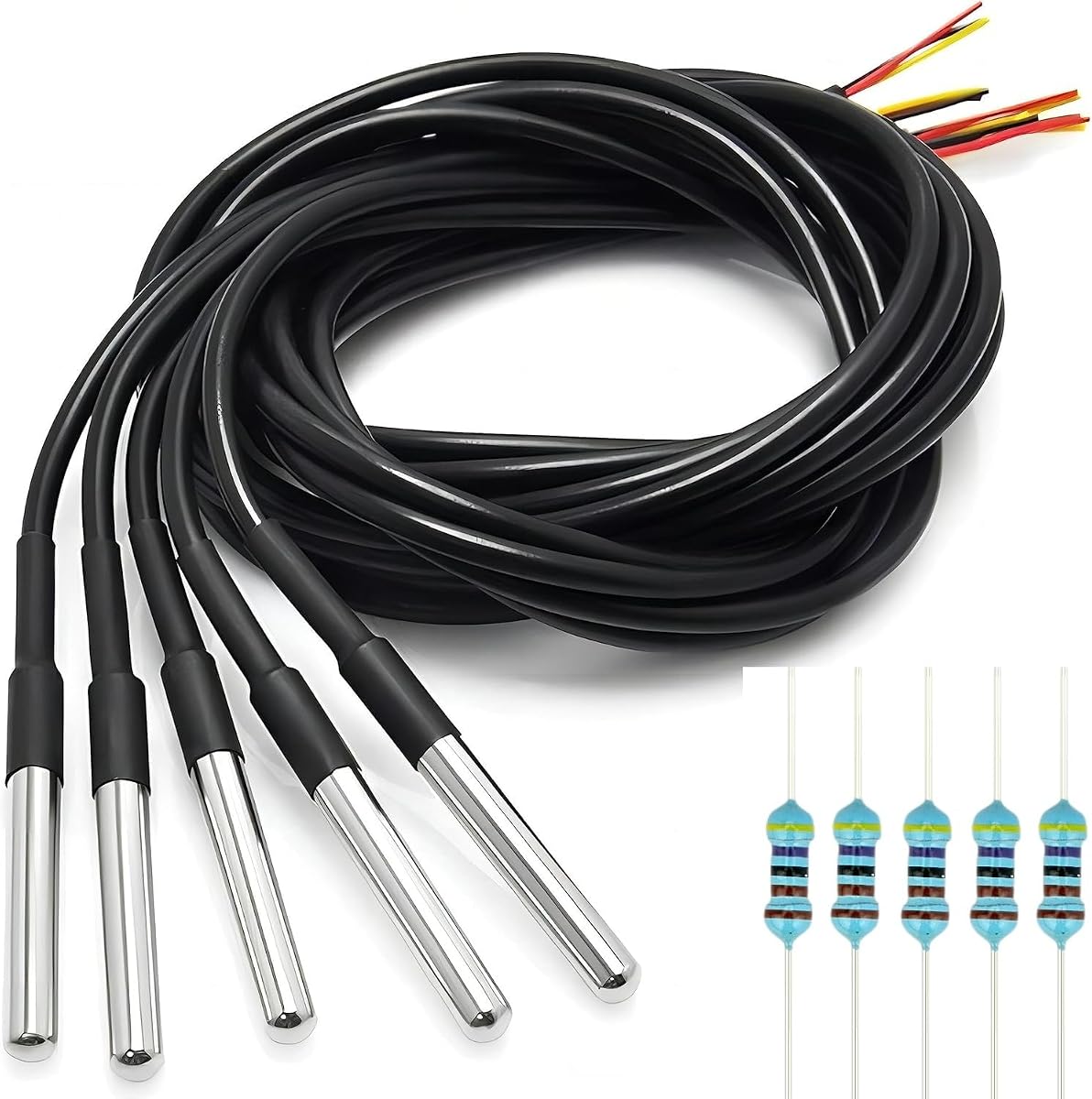
This five pack offers excellent value for those needing multiple sensors for a project. Each probe is waterproof and designed for underwater use without damage. The inclusion of resistors makes it a complete kit for DIY enthusiasts building custom temperature monitoring systems.
We may earn a commission when you buy through this link, at no additional cost to you.
The DS18B20 chip provides a wide temperature range from minus 55 to 125 Celsius. It is compatible with Arduino and Raspberry Pi making it versatile for different platforms. The waterproof nature ensures it can be used in wet environments safely and reliably over time.
While generally robust some users may need to ensure the wiring is secure for consistent readings. The resistors are separate which allows flexibility but requires assembly. This pack is great for bulk projects or classrooms where multiple students need sensors.
We suggest this for schools or large scale deployments where budget is a concern. The waterproof feature adds versatility for outdoor or industrial use. It is a solid choice for cost effective multi sensor arrays.
Resistors are included so you do not need to buy them separately for your setup.
Compatible with both Arduino and Raspberry Pi allowing easy migration between ecosystems.
We may earn a commission when you buy through this link, at no additional cost to you.
This kit is a basic starter option for learning how to use digital temperature sensors. It comes with wires to make the connection process straightforward for beginners. The DHT11 module provides both temperature and humidity data using a simple digital output protocol.
We may earn a commission when you buy through this link, at no additional cost to you.
The operating voltage is between 3.3 and 5 volts making it compatible with most development boards. Humidity range is between 20 to 95 percent which covers most indoor environments. It is designed for general monitoring tasks where precision is not the primary concern.
The included wires save time on sourcing components but may need replacement if worn out. Accuracy is adequate for hobbyist projects but not for scientific research. It serves as a reliable entry point for new users exploring sensor integration.
We recommend this for students and beginners building their first projects. The simplicity and low cost make it a safe choice to experiment with. It helps build a foundation for understanding more advanced sensors later.
Wires are included so you can plug and play immediately after receiving the package.
Works with Arduino and Raspberry Pi models making it versatile for various DIY setups.
We may earn a commission when you buy through this link, at no additional cost to you.
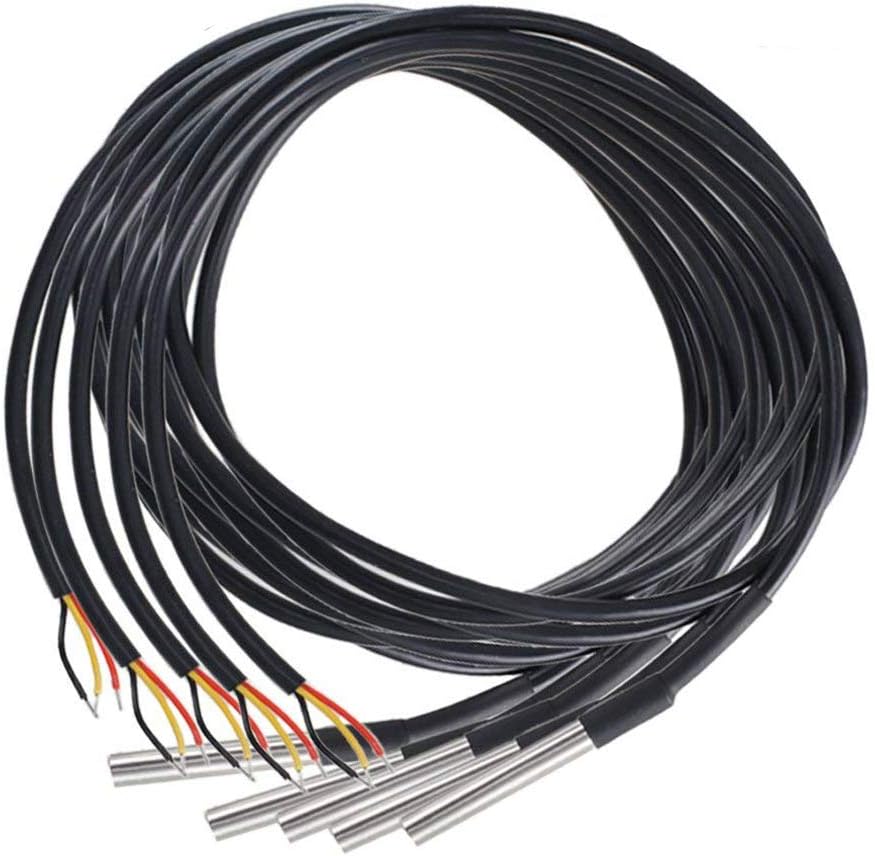
This pack offers five waterproof thermal probes ideal for projects requiring multiple monitoring points. The 100 cm length provides flexibility in positioning sensors across different locations. Each probe is designed for durability and reliable data collection in varied environments.
We may earn a commission when you buy through this link, at no additional cost to you.
The single bus interface allows multiple sensors to share one data line simplifying wiring. It is widely used in industrial systems and consumer products for thermostatic controls. The waterproof nature ensures it can handle wet conditions without damage or performance loss.
Users need to add an external resistor for data stability which is a minor step. The cable length may require management to keep setups tidy. Overall it offers excellent scalability for large scale automation tasks.
We suggest this for agricultural setups or industrial temperature tracking. The bulk quantity reduces cost per unit significantly. It is a robust solution for distributed sensing networks.
Five probes allow you to monitor multiple zones with a single microcontroller setup.
Unique interface supports daisy chaining sensors to save pins on your board.
We may earn a commission when you buy through this link, at no additional cost to you.
This sensor is an upgrade from the DHT11 offering better accuracy and a wider temperature range. It uses the AM2302 chip which provides precise digital readings for temperature and humidity. The package includes two modules which is great for redundancy or multi sensor setups.
We may earn a commission when you buy through this link, at no additional cost to you.
The temperature range extends from minus 40 to 80 degrees Celsius covering most environments. Humidity measurement spans from 0 to 100 percent RH which is full scale. It is designed for electronic practice and DIY projects requiring more reliable data.
The read speed is slower than other sensors but sufficient for most applications. Users need to ensure they use the correct library for compatibility. The fixing screw holes allow for secure mounting in enclosures preventing vibration issues.
We recommend this for weather stations or greenhouses where humidity precision matters. It balances cost and performance effectively. It is a smart choice for intermediate projects needing improved metrics.
Accuracy of plus or minus 0.5 degrees Celsius offers better data than standard basic sensors.
Fixing screw holes help keep the module stable in moving or vibrating environments.
We may earn a commission when you buy through this link, at no additional cost to you.
This pack offers a reliable and durable solution for temperature monitoring projects. The stainless steel probe protects the sensor from physical damage and corrosion. It is waterproof and can be submerged safely in liquids without compromising performance or longevity.
We may earn a commission when you buy through this link, at no additional cost to you.
The 1 meter cable provides ample reach for placing sensors in remote or hard to access areas. With five units in the pack you have enough for extensive testing or multiple zones. The operating voltage is between 3.0 and 5.5 volts ensuring compatibility with most systems.
Accuracy is standard for this class of sensor but adequate for most uses. You may need to add an external resistor for optimal signal stability. It is a cost effective choice for those needing multiple waterproof probes.
We suggest this for outdoor weather tracking or industrial monitoring. The durability and quantity make it a great value. It is a solid foundation for building a resilient temperature network.
Stainless steel casing prevents rust in outdoor or humid conditions extending the sensor life.
The 1 meter cable allows you to place the sensor away from the electronics safely.
We may earn a commission when you buy through this link, at no additional cost to you.
Selecting the right sensor depends on your project requirements such as accuracy range and environmental conditions. This guide outlines the critical factors to consider before making your final decision.
Accuracy is a crucial factor that determines how close your readings are to the actual temperature. For scientific or industrial applications look for sensors with plus or minus 0.5 degrees Celsius or better. Basic hobby projects can often tolerate lower accuracy such as plus or minus 2 degrees.
Prioritize higher accuracy if your data will trigger critical actions or control systems.
Check the operating temperature range to ensure it covers your expected conditions. Standard sensors work from 0 to 50 degrees but specialized ones go from minus 40 to 125 degrees. Freezers or boilers require wider ranges to function correctly in extreme environments.
Choose a sensor that exceeds your minimum and maximum expected temperatures by a safe margin.
Different sensors use different protocols like 1 Wire I2C or Single Bus. I2C allows multiple devices on two wires which simplifies wiring. 1 Wire uses one data line which is great for long distances and saving pins on your board.
Ensure your microcontroller supports the protocol or that you have the necessary libraries available.
If your project involves liquids or high humidity waterproof probes are essential. Look for stainless steel casings or silicone sealed units that prevent water ingress. Some kits include adapters that make waterproof installation easier without extra soldering.
Always verify the IP rating or waterproof rating before submerging any sensor.
Ensure the sensor operates within the voltage range of your Arduino board. Most work from 3.3 to 5.5 volts but some require specific levels like 3.3 volts only. Using the wrong voltage can damage the sensor or produce erratic readings.
Match the supply voltage to your board logic level for stable operation.
Buying in bulk often reduces cost per unit and is useful for large projects. Some packs include resistors or wires which adds value and convenience. Plan how many sensors you need upfront to avoid running out mid project.
Consider multi pack options if you plan to build multiple prototypes or systems.
Simpler wiring reduces the risk of errors for beginners. Modules with pull up resistors built in make assembly faster. Check if jumper wires are included or if you need to buy them separately.
Select a module that minimizes extra components to save time on setup.
Some sensors take longer to stabilize and provide readings than others. Fast response is needed for control loops that react quickly to temperature changes. Slower sensors are fine for periodic monitoring where speed is not critical.
Prioritize faster response times if your system requires real time adjustments.
Connect the sensor to your Arduino by matching the VCC GND and Data pins according to the datasheet. Ensure all connections are secure to avoid intermittent data loss or errors during operation.
Install the required library in the Arduino IDE to read values from the sensor. Use example code provided with the library to verify that the sensor is functioning correctly before integrating into your project.
Protect the sensor from direct sunlight or physical damage to ensure accurate readings. If using outdoors place it in a shaded enclosure with airflow to avoid false heat measurements from sun exposure.
For indoor monitoring the DHT11 or DHT22 modules are excellent choices due to their low cost and ease of use. They provide sufficient accuracy for home automation and weather stations. Choose DHT22 if you need better precision in humidity readings.
Yes but you should choose a waterproof model like the DS18B20 stainless steel probes. Ensure the electronics are housed in a weatherproof enclosure to prevent rain from damaging the board. Proper shielding ensures longevity in outdoor conditions.
Some sensors come with a pull up resistor on the adapter module while others require an external one. Check the product details or datasheet to confirm. If using DS18B20 typically a 4.7K resistor is needed between data and power.
Accuracy varies by model. Basic sensors like DHT11 have plus or minus 2 degrees Celsius accuracy while high precision ones like SHT31 offer plus or minus 0.3 degrees. Check the specifications to match your project needs.
Yes you can connect multiple sensors using specific wiring protocols. DS18B20 sensors can be connected on a single wire using unique IDs. I2C sensors can be daisy chained to save digital pins on your board.
Most Arduino sensors are programmed using C++ through the Arduino IDE. You can use provided libraries to simplify coding. Other platforms like MicroPython on ESP32 also support these sensors with similar ease.
Yes many of these sensors work with Raspberry Pi. DS18B20 is particularly popular for Pi due to its direct GPIO connection. Libraries like Adafruit DHT are available for both Arduino and Pi environments.
Quality sensors can last several years if not exposed to extreme conditions beyond their specs. Avoid exposing them to temperatures outside their rated range. Proper storage and handling ensure optimal lifespan for long term projects.
Choosing the right temperature sensor depends on your specific needs for accuracy range and environmental conditions. We have highlighted top picks that cater to beginners and advanced developers alike. Whether you need basic monitoring or industrial precision there is a sensor on this list for you.
Prioritize factors like waterproofing and communication protocol based on your project environment. If you need high accuracy consider the SHT31 or AHT30. For cost effectiveness the DHT11 or DS18B20 packs offer excellent value.
Always check current availability and stock before purchasing to ensure you get the components you need. Prices and stock may change so verifying details with the seller is recommended. Happy building with your new temperature monitoring setup.